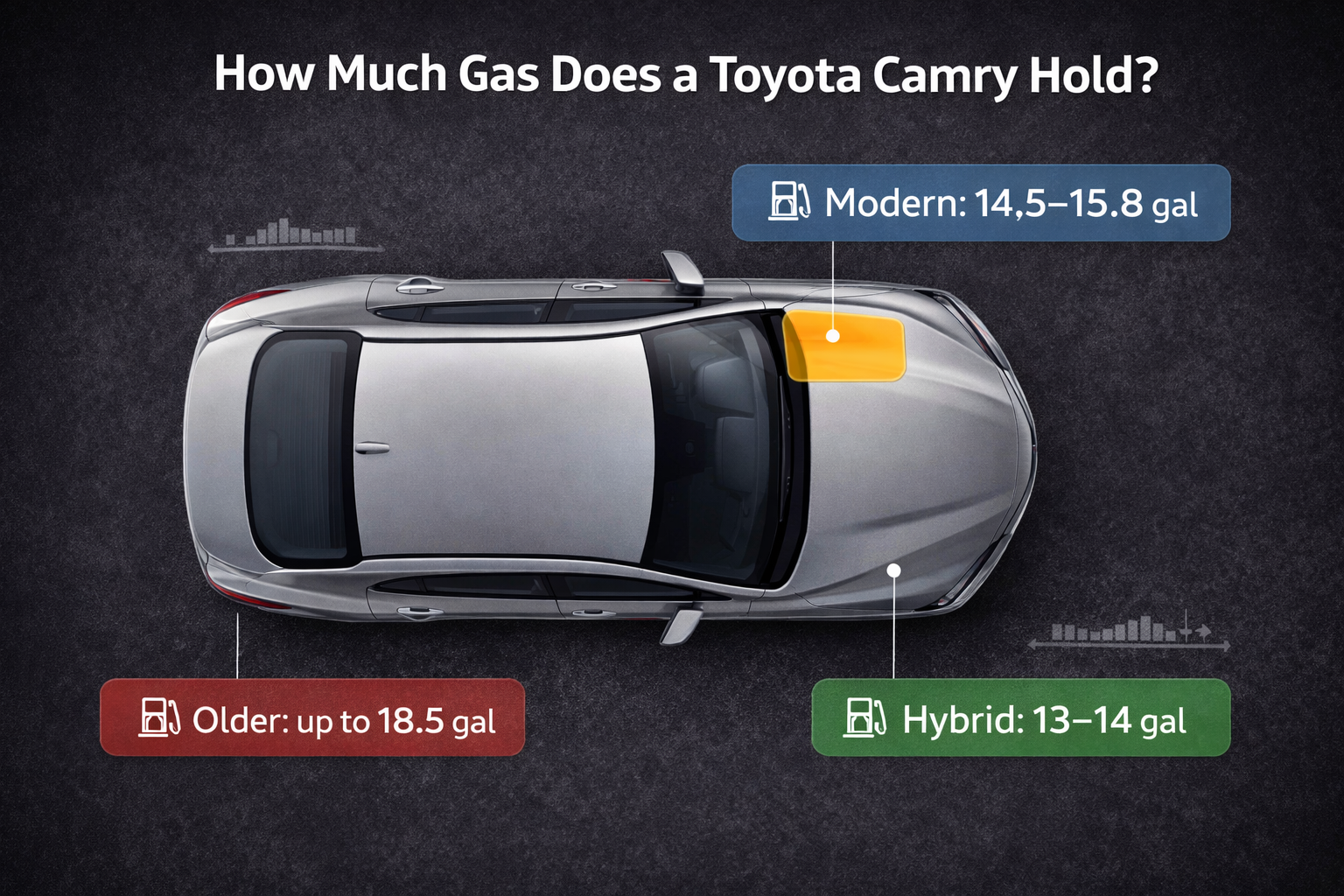
How Much Gas Does a Toyota Camry Hold? (See Gas Capacity)
A Toyota Camry typically holds 14.5 to 15.8 gallons in modern models, while hybrids hold 13 to 14 gallons. Older models reached up to 18.5 gallons, but newer designs focus on efficiency and range. This guide breaks down exact gas capacities, range, and practical tips for every model year.
This guide breaks it down clearly, showing how much gas does a Toyota Camry hold for every model year, giving accurate, practical insights.
How Many Gallons Does a Toyota Camry Hold Exactly?
How much gas does a Toyota Camry hold exactly? Most Toyota Camry models hold between 14.5 and 15.8 gallons of gas. Hybrid variants usually have slightly smaller tanks, while older models had larger ones.
Gas models (2018 to 2024): around 15.8 gallons
Hybrid variants: around 13.2–13.5 gallons
Older models (pre-2012): up to 18.5 gallons
In simple terms, modern Camrys hold less fuel but still go farther.
From real owner reports, many drivers notice that hybrid versions still cover more miles despite smaller tanks. Most owners report that highway trips often exceed the expected miles, while city traffic can reduce range. Real-world results vary.
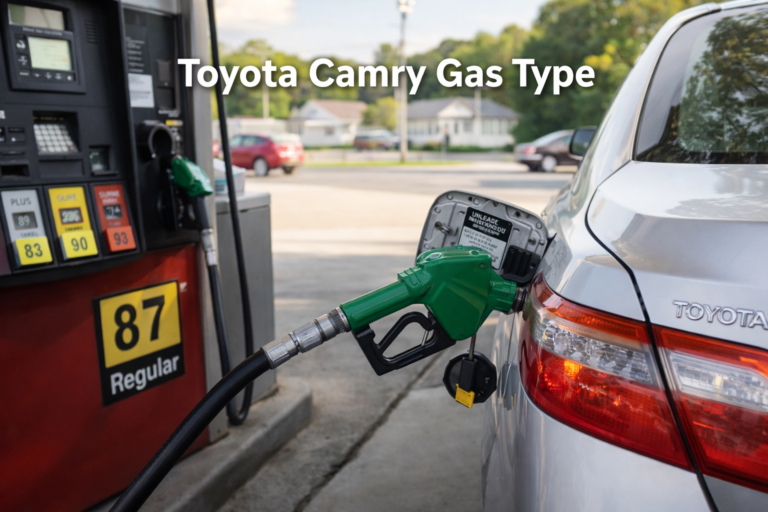
Read Guide: Toyota Camry Gas Type
Official Toyota specifications confirm these capacities (Toyota USA) and Edmunds fuel data.
How Has the Toyota Camry Fuel Tank Size Changed Over the Years?
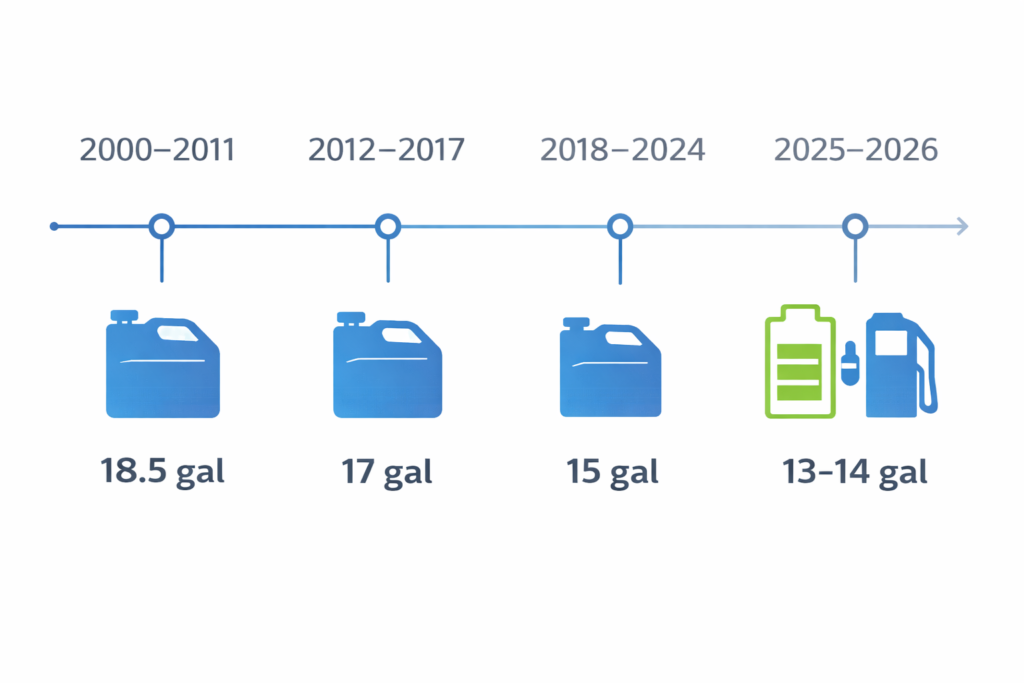
Toyota did not randomly change tank size; it followed efficiency trends. Older cars needed bigger tanks because they burned more fuel.
| Model Years | Fuel Tank Size | Notes |
| 2000 to 2011 | 18.5 gallons | Larger tanks, lower MPG |
| 2012 to 2017 | 17 gallons | Improved efficiency |
| 2018 to 2024 | 14.5–15.8 gallons | Lighter, more efficient |
| 2025 to 2026 | 13–14 gallons | Hybrid-focused redesign |
Even though the tank got smaller, the range did not drop much because fuel economy improved a lot.
Official fuel capacity is measured under standard conditions, but usable fuel may vary depending on temperature and driving habits.
Do Hybrid Camry Models Hold Less Gas Than Gas Versions?
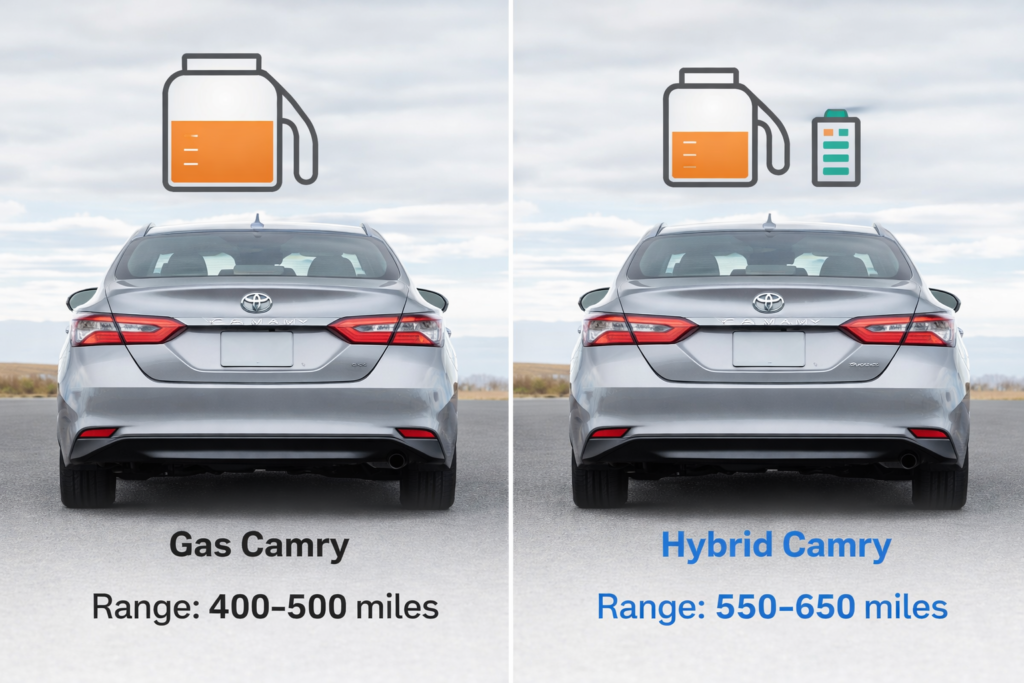
Yes, hybrid Camry models usually have a smaller gas tank. But that does not mean a worse range.
| Model Type | Fuel Tank Size | Estimated Range |
| Gas (2018 to 2024) | 15–16 gallons | 400 to 500 miles |
| Hybrid (2018 to 2026) | 13–14 gallons | 550 to 650 miles |
Even with smaller tanks, hybrids often travel farther thanks to electric assistance.
The reason is simple: hybrids use electric power, so they do not need as much fuel stored. In real driving, many hybrid owners still get 600+ miles per tank, which often beats gas models.
In real driving conditions, highway trips often give better range, while city traffic can reduce total miles per tank.
Also Read: Is Toyota Dynamic Navigation Worth It?
How Far Can a Toyota Camry Go on a Full Tank?
This depends on engine type and driving style, but most Camrys can go 400 to 650 miles on a full tank.
Gas models: 400 to 500 miles
Hybrid variants: 550 to 650 miles
Example:
If your Camry gets 40 MPG and has a 14-gallon tank, you are looking at around 560 miles of range.
How Much Gas Is Left When the Fuel Light Turns On in a Camry?
When the fuel light comes on, your Camry still has about 2 to 3 gallons left.
Remaining fuel: 2–3 gallons
Safe range: 40–80 miles
Real-world tip:
Do not push it too far. Driving too low on fuel can damage the fuel pump over time.
Many mechanics recommend refueling early because running too low repeatedly can stress the fuel system over time.
Why does my Camry tank not fill?
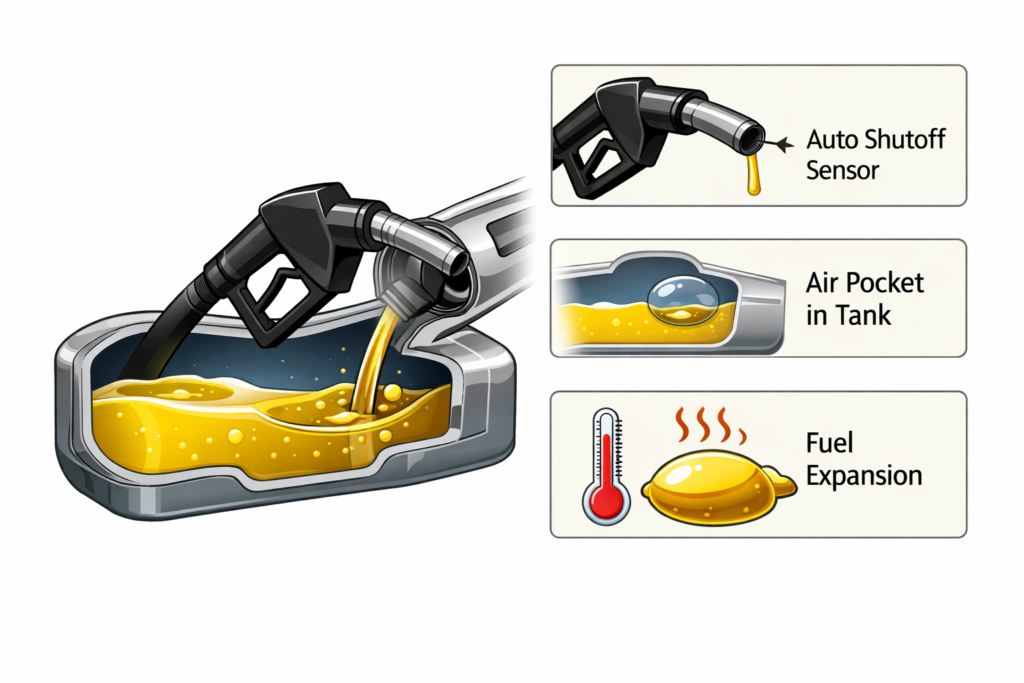
If your tank does not fill fully, it is usually normal, not a fault.
Common Reasons
- Fuel pump auto shutoff stops early
- Air inside the tank prevents full fill
- Temperature changes affect fuel expansion
This is normal behavior, not a defect, and happens in most modern cars due to safety and fuel system design.
Does Fuel Tank Size Change by Camry Trim Level?
No, fuel tank size usually stays the same across trims like LE, SE, XLE, and XSE.
Same engine = same tank size
Hybrid trims = smaller tank
What changes is fuel efficiency, not tank capacity.
Higher trims may feel different, but the tank size is typically identical.
What Is the Typical Fuel Tank Size for Most Camry Models?
For most modern models, the typical Toyota Camry tank size is around 14.5 to 15.8 gallons.
Most common size: 15 gallons
Hybrids: slightly smaller
Older models: larger but less efficient
Final takeaway:
Even though newer Camrys hold less gas, they are designed to go just as far or even farther on a full tank.
FAQs:
Does a Toyota Camry hold more than 15 gallons?
Yes, older Camry models (pre-2012) can hold up to around 18.5 gallons.
Can a Camry hybrid go farther than a gas model?
Yes, hybrid Camrys often deliver more range despite having smaller fuel tanks.
How many gallons does a 2025 Toyota Camry hold?
Most 2025 Camry models hold around 13 to 14 gallons due to the hybrid design.
What determines the Toyota Camry’s fuel tank size?
Fuel tank size depends on model year, engine type, and hybrid system design.
Is the Camry fuel tank size different in all trims?
No, fuel tank size is usually the same across trims unless it is a hybrid variant.
Conclusion:
Toyota Camry fuel tank size has changed over time, but the goal is clear: better efficiency and a smarter driving range. Newer models may hold less gas, but they use it more effectively, especially hybrid versions. From real owner experiences, these cars often cover more miles than expected, even with smaller tanks. What matters is not just tank size, but how far the car can go in real conditions. That is where modern Camry models stand out.