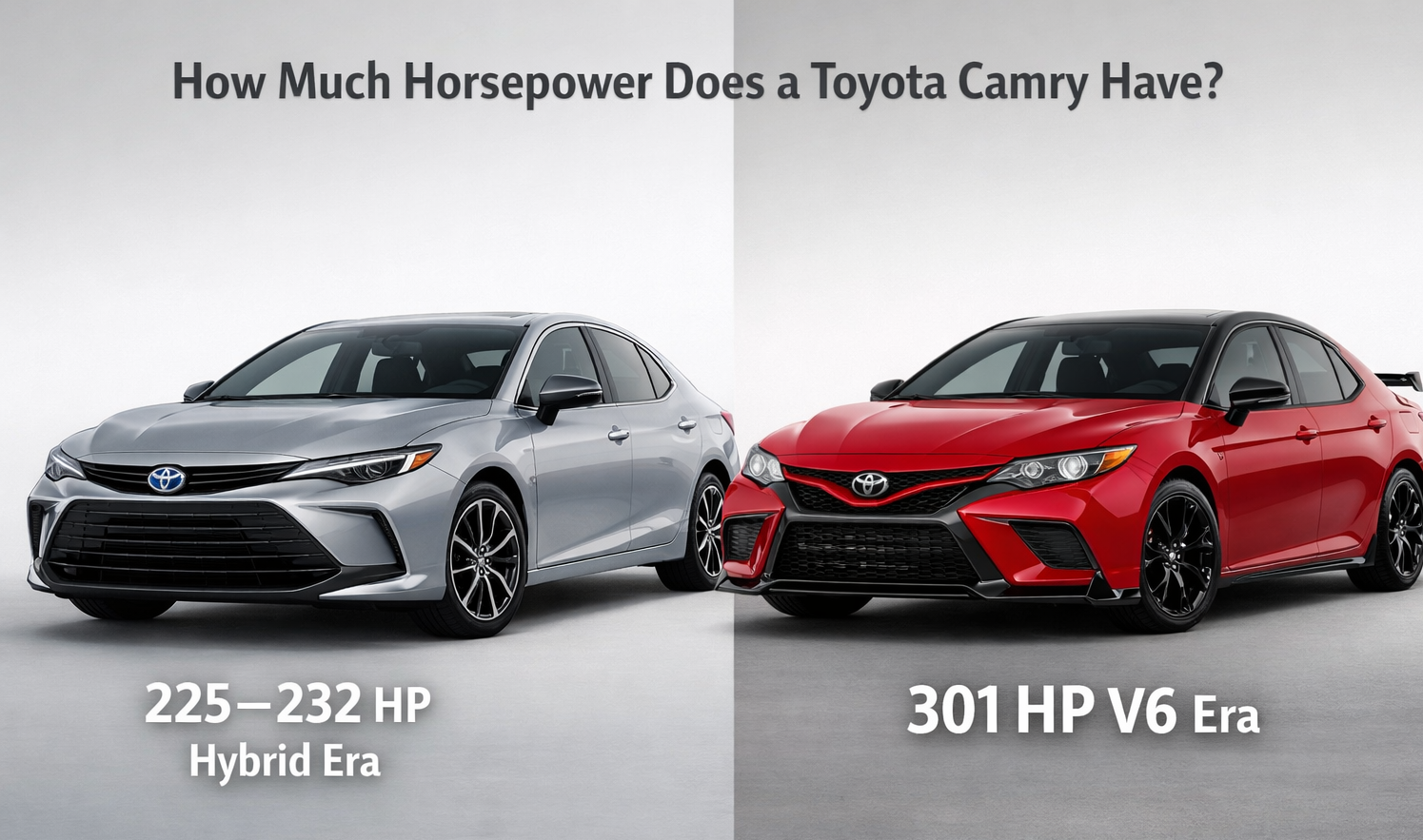
How Much Horsepower Does a Toyota Camry Have? (Compare Models)
The Toyota Camry typically produces between 203 and 301 horsepower, depending on the engine and model year. 2.5L 4-cylinder Camry: 203–206 hp, 3.5L V6 Camry: up to 301 hp, Hybrid Camry: 208–232 hp combined. Older Camry models from the 1990s produced as little as 115 hp, while the most powerful Camry ever sold in the U.S. reached 301 hp.
Below is the complete horsepower breakdown: How Much Horsepower Does a Toyota Camry Have? by year, engine type, and generation.
Toyota Camry Horsepower Quick Answer
The Toyota Camry produces between about 203 and 301 horsepower, depending on the engine and model year.
- 4-Cylinder Camry: 203 to 206 hp
- V6 Camry: up to 301 hp
- Hybrid Camry: 208 to 232 hp
- Most powerful Camry ever: 301 hp
Older Camry models from the early 1990s produced around 115 horsepower, while modern hybrid models focus on efficiency while still delivering strong everyday performance.
Toyota Camry Engine Horsepower by Engine Type
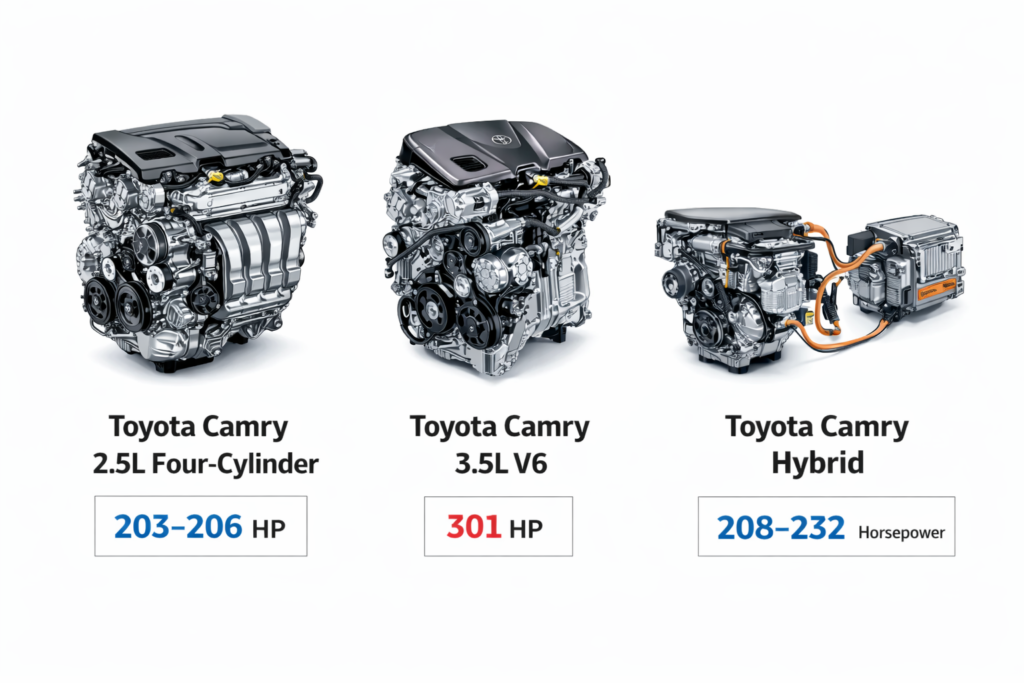
Different Camry engines produce different horsepower levels. Over the years, the sedan has been offered with four-cylinder, V6, and hybrid powertrains.
| Engine | Horsepower | Years Used |
| 2.5L 4-Cylinder | 178–206 hp | 2012 to 2024 |
| 3.5L V6 | 268–301 hp | 2007 to 2024 |
| Hybrid System | 200–232 hp | 2012 to 2026 |
| 2.2L 4-Cylinder | 115–130 hp | 1990 to 2001 |
These numbers show how Toyota gradually increased power while improving efficiency and emissions across multiple generations.
Toyota Camry 4-Cylinder Horsepower
Most Toyota Camry models use a naturally aspirated 2.5-liter four-cylinder engine. In modern versions, this engine produces between 203 and 206 horsepower depending on the trim level.
For everyday driving, this level of power is more than enough for highway merging and city acceleration. In real-world use, many drivers appreciate the balance between performance, reliability, and fuel efficiency that the Camry’s four-cylinder engine provides.
Across several generations, the four-cylinder has remained the most popular engine choice for the Camry.
Toyota Camry V6 Horsepower
For buyers wanting stronger acceleration, Toyota offered a 3.5-liter V6 engine in several Camry generations. The most powerful version produced 301 horsepower and 267 lb-ft of torque.
This engine was available in trims like the XSE V6 and the sport-focused TRD model. In testing by automotive publications, V6 Camry models could reach 0–60 mph in under six seconds, which is unusually quick for a midsize family sedan.
Toyota discontinued the V6 after the 2024 model year as the brand shifted toward hybrid powertrains.
Toyota Camry Hybrid Horsepower
Hybrid Camry models combine a 2.5-liter gasoline engine with an electric motor system. Earlier hybrids produced about 200 to 208 horsepower, while the newest generation produces between 225 and 232 horsepower, depending on drivetrain.
Although hybrid horsepower numbers look lower than the old V6, the electric motors deliver instant torque. In daily driving, this makes hybrid Camry models feel responsive during city acceleration and stop-and-go traffic.
The hybrid system now powers all new Camry models starting from the 2025 redesign.
What Is the Horsepower of the 2026 Toyota Camry?
The 2026 Camry is built on Toyota’s TNGA platform and comes only as a hybrid. There is no longer a naturally aspirated V6.
- FWD Hybrid: 225 horsepower
- AWD Hybrid: 232 horsepower
- 2.5L engine displacement
- Electronic CVT
- Dual motor setup (rear motor in AWD)
In real-world driving, the AWD model feels stronger below 40 mph because electric torque hits instantly. At highway speeds, it does not pull like the old V6, but it is smoother and far more efficient.
Read Guide: Is Toyota Camry AWD?
How Much Horsepower Does the 2025 Toyota Camry Hybrid Produce?
The 2025 Camry redesign removed all pure gasoline engines.
| Drivetrain | Engine Type | Combined Horsepower |
| FWD | 2.5L Hybrid | 225 hp |
| AWD | 2.5L Hybrid | 232 hp |
This is a combined system output, not just engine horsepower. Real-world testing shows 0–60 mph in the mid-6-second range for AWD, which is close to older V6 models but with much better fuel economy.
How Much Horsepower Did the 2018 to 2024 Toyota Camry Make?
This generation gave buyers three clear choices.
| Engine | Horsepower | Trims |
| 2.5L 4-Cylinder | 203 hp (206 hp in XSE) | LE, SE, XLE, XSE |
| 3.5L V6 | 301 hp | XSE V6, TRD |
| 2.5L Hybrid | 208 hp | LE, SE, XLE |
The 301-hp V6 was the strongest Camry ever sold in the U.S. The TRD trim looked sportier but made the same power as the XSE V6. If you wanted a real punch before 2025, this was the one to get.
From a driving perspective, the 301-hp V6 felt strongest during highway pulls above 60 mph. The new hybrid, however, feels quicker in stop-and-go traffic because electric motors deliver torque instantly. Different power delivery, different feel.
Independent testing from Car and Driver shows the 301-hp Camry reaching 0–60 mph in roughly 5.8 seconds, making it one of the quickest non-luxury midsize sedans.
2024 Toyota Camry horsepower
The 2024 Toyota Camry offers three engine options with different horsepower outputs.
- 2.5-liter four-cylinder: 203 hp (206 hp in XSE trim)
- 3.5-liter V6: 301 hp
- Hybrid system: 208 hp combined
Among these, the V6 version delivers the highest performance, while the hybrid focuses on fuel efficiency with smooth acceleration.
How Much Horsepower Does the Camry TRD Have?
The Toyota Camry TRD uses a 3.5-liter V6 engine producing 301 horsepower and 267 lb-ft of torque.
Toyota introduced the TRD trim for the 2020 model year as the sportiest Camry variant. It included performance-focused upgrades such as a sport-tuned suspension, larger brakes, and aerodynamic styling.
Although the TRD did not increase horsepower compared to the XSE V6, it offered a more aggressive driving feel and quicker handling.
What Was the Horsepower of the 2012 to 2017 Camry?
Power improved compared to earlier generations.
- 2.5L 4-cylinder: 178–181 hp
- 3.5L V6: 268 hp
- Hybrid: 200 hp (combined)
The V6 here was strong for its time and paired with a traditional 6-speed automatic. Many buyers who use this setup still prefer it for its mechanical simplicity and proven reliability.
How Much Horsepower Did Older Camry Models Have?
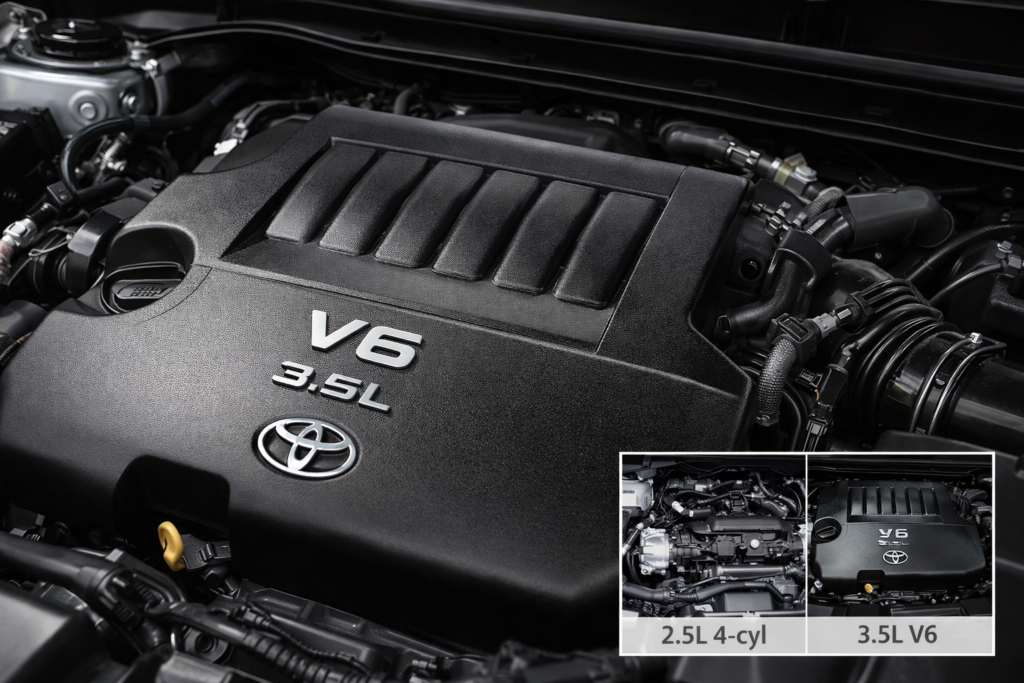
How Much Horsepower Does a Toyota Camry Have? Horsepower gradually increased as engines became more refined and efficient.
Full Toyota Camry Horsepower History
Toyota Camry horsepower has increased significantly over the decades as engine technology has improved. The table below shows the horsepower range for each generation.
| Generation | Years | Engine | Top HP |
| XV10 | 1990 to 1996 | 2.2L 4-Cylinder / 3.0L V6 | 115–188 hp |
| XV20 | 1997 to 2001 | 2.2L 4-Cylinder / 3.0L V6 | 133–194 hp |
| XV30 | 2002 to 2006 | 2.4L 4-Cylinder / 3.0L V6 | 157–210 hp |
| XV40 | 2007 to 2011 | 2.4L 4-Cylinder / 3.5L V6 | 158–268 hp |
| XV50 | 2012 to 2017 | 2.5L 4-Cylinder / 3.5L V6 / Hybrid | 178–268 hp |
| XV70 | 2018 to 2024 | 2.5L 4-Cylinder / 3.5L V6 / Hybrid | 203–301 hp |
| XV80 | 2025 to 2026 | 2.5L Hybrid | 225–232 hp |
Early Camry models focused mainly on reliability and comfort rather than performance. The biggest horsepower jump came in 2007 when Toyota introduced the 3.5-liter V6 producing up to 268 horsepower.
Why Hybrid Camry Horsepower Feels Different?
Although hybrid Camry models have lower peak horsepower numbers than the older V6, they often feel quicker during city driving.
This happens because electric motors deliver instant torque the moment the accelerator is pressed. In contrast, gasoline engines usually build power gradually as RPM increases.
As a result, a 225-horsepower hybrid Camry can feel surprisingly responsive in stop-and-go traffic even compared with a 301-horsepower V6 model.
Toyota Camry engine horsepower has increased steadily over the past three decades as Toyota introduced more powerful and efficient powertrains.
Why Toyota Discontinued the Camry V6?
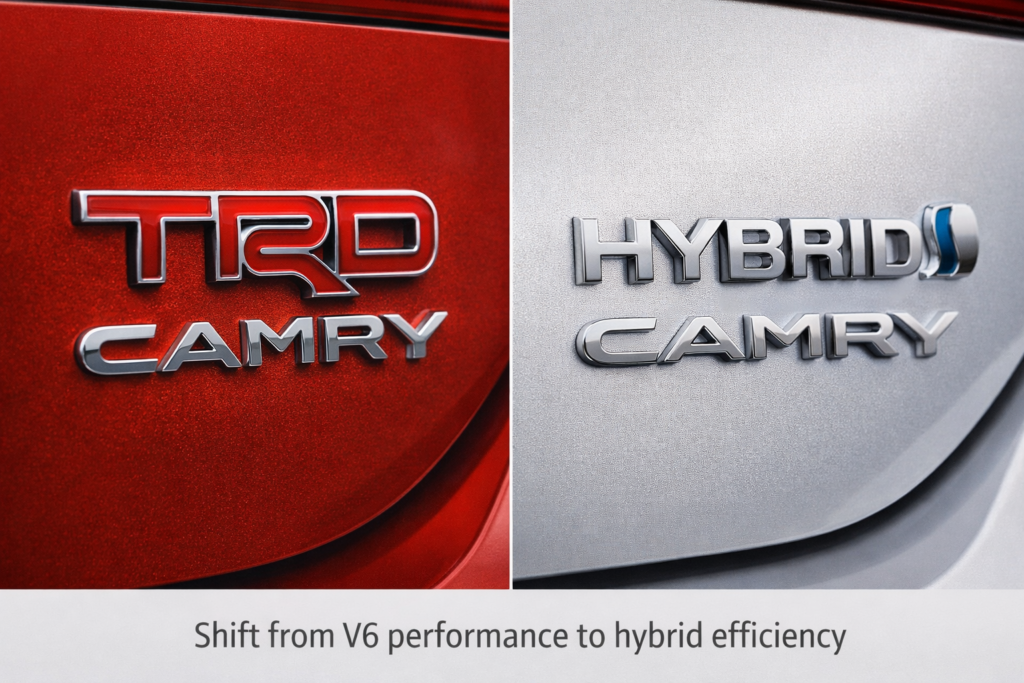
Toyota discontinued the Camry V6 after the 2024 model year, mainly due to emissions regulations and changing buyer demand.
Stricter fuel-economy standards and the rapid growth of hybrid technology made it harder to justify a large naturally aspirated V6 engine in a mainstream sedan.
Most Camry buyers were already choosing four-cylinder or hybrid models, so Toyota replaced the V6 with a more powerful hybrid system starting in the 2025 redesign.
More details in Toyota’s official announcement.
Which Toyota Camry Had the Most Horsepower?
The most powerful Camry ever sold in the United States used a 3.5-liter V6 producing 301 horsepower.
This engine was available in the 2018–2024 Camry XSE V6 and the performance-focused TRD trim.
In independent testing by Car and Driver, this version could accelerate from 0 to 60 mph in about 5.8 seconds, making it one of the quickest midsize sedans in its class.
Is the Toyota Camry Fast for a Midsize Sedan?
Performance depends on the engine. The 301-horsepower V6 Camry was one of the fastest non-luxury midsize sedans available.
Even the newer hybrid models provide strong real-world performance. Instant electric torque helps them accelerate smoothly in city driving and merge confidently on highways.
For most drivers, modern Camry horsepower levels are more than enough for daily driving and long-distance travel.
In everyday driving, most Camry owners rarely use the full horsepower available. Instead, smooth acceleration, fuel efficiency, and reliability matter more.
For example, the 203-hp four-cylinder engine provides enough power for highway merging and passing, while hybrid models deliver instant electric torque that feels responsive in city traffic.
Camry vs Accord Horsepower Comparison
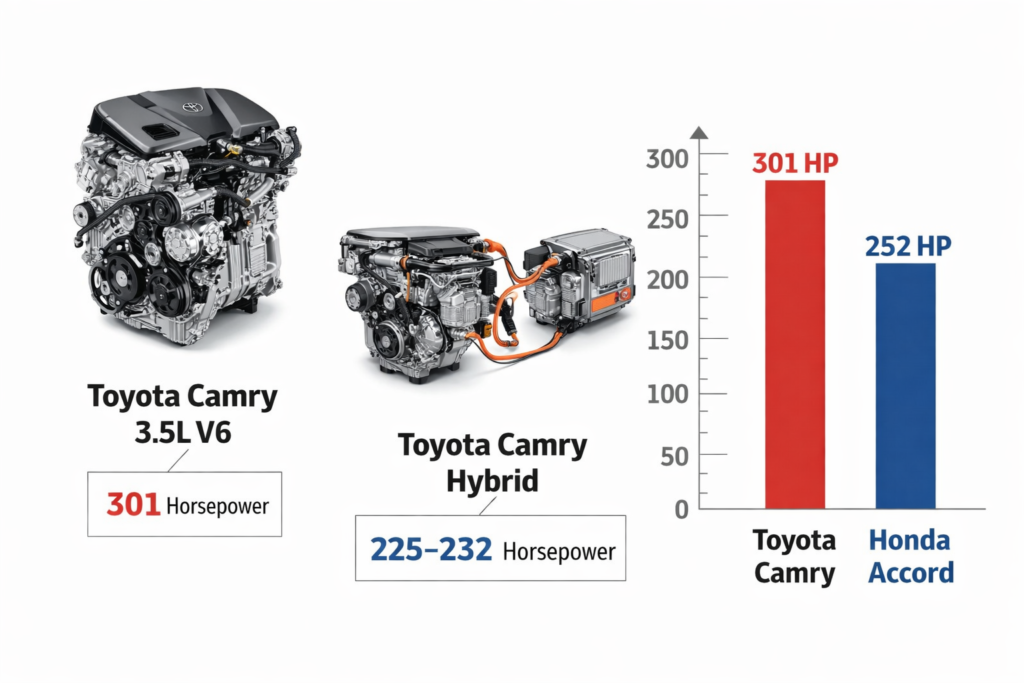
| Model | Engine | Horsepower |
| Camry V6 (2018–2024) | 3.5L V6 | 301 hp |
| Camry Hybrid (2025 to 2026) | 2.5L Hybrid | 225–232 hp |
| Accord Hybrid (Current) | 2.0L Hybrid | ~204 hp |
Earlier V6 Camry models clearly led in peak horsepower. Today’s hybrid Camry still produces more power than the current Honda Accord hybrid while delivering excellent fuel economy.
According to independent testing by Car and Driver, the 301-hp V6 Camry can accelerate from 0–60 mph in around 5.8 seconds, making it one of the quickest midsize sedans of its generation.
Data Sources and Specifications
The horsepower figures in this guide are based on manufacturer specifications and independent automotive testing.
Primary reference data comes from official Toyota Camry specifications, as well as vehicle testing and specifications published by automotive research sites such as Car and Driver and Edmunds.
FAQs:
What is the horsepower of a 2024 Toyota Camry?
The 2024 Toyota Camry produces 203–206 horsepower with the 2.5-liter four-cylinder engine, while the V6 version delivers up to 301 horsepower.
How much horsepower does the Camry TRD have?
The Camry TRD produces 301 horsepower from its 3.5-liter V6 engine and 267 lb-ft of torque.
Is a 301 hp Camry fast?
Yes. A 301-horsepower Camry can accelerate from 0–60 mph in about 5.8 seconds, which is quick for a midsize sedan.
What Camry has the most horsepower?
The most powerful Camry ever produced was the 2018–2024 V6 model with 301 horsepower.
Is Camry’s horsepower higher than Accord’s?
Yes, in some cases. The V6 Camry produced 301 horsepower, while current Honda Accord hybrid models produce about 204 horsepower.
Conclusion:
The Toyota Camry produces anywhere from about 203 horsepower in modern four-cylinder models to 301 horsepower in the most powerful V6 versions. Although Toyota has discontinued the V6, the newest hybrid Camry still delivers strong real-world performance while improving fuel efficiency. For most drivers, today’s Camry horsepower levels provide more than enough power for daily commuting, highway merging, and long-distance driving.