What Type of Gas Does a Toyota Camry Take? (Find Out Now)
If you have ever stood at a gas pump second-guessing which fuel your Toyota Camry actually needs, you are not alone. It is one of the most common questions new and used Camry owners search for, and the answer is simpler than you had thought.
The Toyota Camry runs on regular unleaded 87 octane gasoline across nearly every model year, trim, and engine type, including the hybrid. No premium required, no special blend needed.
In this guide, we will cover the exact fuel type for every Camry generation, whether premium gas is ever worth it, and what happens if you accidentally use the wrong fuel.
What Type of Gas Does a Toyota Camry Take?
The Toyota Camry takes regular unleaded 87 octane gasoline. This applies to all trims: LE, SE, XLE, XSE, TRD, and both the standard and hybrid models. Toyota does not recommend or require premium fuel for any current Camry variant.
The Short Answer: Regular 87 Octane
Toyota officially recommends regular unleaded gasoline with a minimum of 87 octane for the vast majority of Camry models. This applies to both the 4-cylinder (2.5L) and V6 (3.5L) engines. You can confirm this by checking the label inside your fuel door or referencing your owner’s manual; both will say the same thing: 87 regular.
Does Any Toyota Camry Require Premium Gas?
No current Toyota Camry requires premium gas. There is an important difference between required and recommended premium: neither is required for any Camry trim. While some high-performance or luxury trims like the XSE V6 may see marginal octane tolerance up to 89 to 91, Toyota does not mandate it, and real-world gains are negligible for the average driver.
Toyota Camry Fuel Requirements by Generation & Year
Read Our Guide On: What Year Toyota Camry Should You Avoid?
2018 to 2024 Toyota Camry (8th Generation)
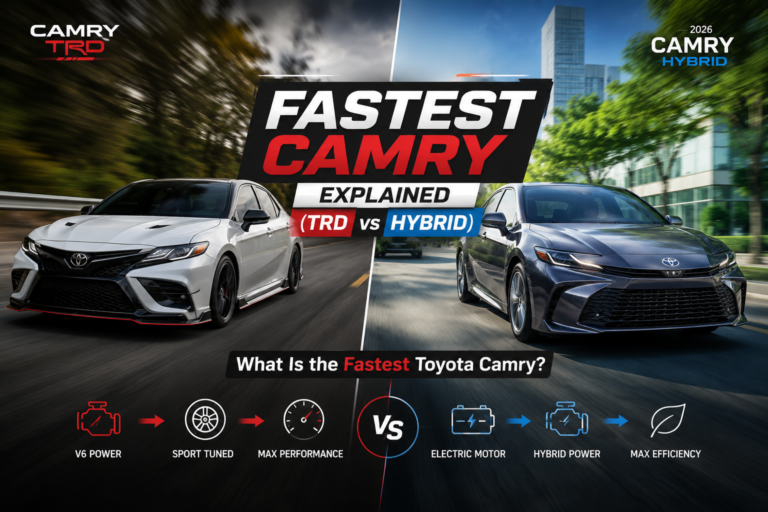
The 8th-generation Camry covers the widest range of trims in the model’s history, and all of them run on regular 87 octane. Engine options include the 2.5L 4-cylinder, 3.5L V6, and 2.5L Hybrid. Whether you are driving the base LE, the sporty TRD, or the premium XLE, the fuel requirement is identical. The hybrid’s electric motor assists the gas engine but does not change the octane requirement; you still fill up with regular 87.
2012 to 2017 Toyota Camry (7th Generation)
The 7th-generation Camry offered a 2.5L 4-cylinder, 3.5L V6, and 2.5L Hybrid across trims. All run on regular 87 octane. A common misconception is that the V6 engine needs a higher-octane fuel; it does not. Toyota specifically engineered this engine to perform optimally on regular unleaded, and upgrading to premium offers no measurable benefit.
2007 to 2011 Toyota Camry (6th Generation)
The 6th-generation Camry used a 2.4L 4-cylinder, 3.5L V6, and 2.4L Hybrid, all requiring regular 87 octane. Older engines in this generation benefit most from consistently fresh, high-quality fuel sourced from reputable stations. If your Camry has high mileage, consider using a fuel system cleaner additive periodically to keep injectors clean and combustion efficient.
Pre-2007 Toyota Camry (Older Generations)
Camry models built before 2007 also generally run on regular 87 octane, though specifications varied slightly by market and engine configuration. Always cross-check your owner’s manual for your exact year. For high-mileage vehicles in this range, using a Top Tier certified fuel and occasional fuel system cleaners is a smart long-term investment.
Toyota Camry Hybrid Does It Use Different Gas?
How the Hybrid System Affects Fuel Choice
The Toyota Camry Hybrid is a self-charging hybrid, not a plug-in electric vehicle. This means it still relies entirely on gasoline as its primary energy source; the electric motor only assists during acceleration and at low speeds to improve fuel economy. Despite this dual-power system, the fuel requirement does not change: regular 87 octane is all you need. There is no special hybrid fuel, additive, or blend required.
Also Read: How Does the Toyota Camry Hybrid Really Work?
Can You Use E85 or Flex-Fuel in a Camry Hybrid?
No. The Toyota Camry hybrid, or otherwise, is not a flex-fuel vehicle and is not compatible with E85 ethanol blends. Using E85 in a Camry can corrode fuel lines, damage injectors, and degrade rubber seals throughout the fuel system. Stick exclusively to regular unleaded gasoline. If your station offers E10 (10% ethanol blend), that is fine; most standard gasoline in the U.S. already contains up to 10% ethanol and is safe for your Camry.
Regular vs. Premium Gas in a Toyota Camry: Is It Worth It?
What Happens If You Put Premium in a Camry?
Putting premium (91 to 93 octane) in a Toyota Camry won’t damage the engine, but you won’t get your money’s worth either. Modern ECUs (engine control units) are specifically calibrated for 87 octane fuel. Feeding the engine a higher octane than it is designed for does not unlock extra power; it simply burns more expensive fuel with the same result. The extra cost per gallon adds up over time without any performance, MPG, or longevity benefit.
What Happens If You Put 85 Octane (Low-Grade) in a Camry?
Using 85 octane sub-regular fuel is not recommended for the Camry, particularly at lower altitudes where the engine operates under higher combustion pressure. Lower octane fuel is more prone to pre-ignition, which causes engine knock or pinging, a condition where the fuel-air mixture ignites before the spark plug fires. Over time, repeated engine knock causes measurable wear. Always treat 87 as your absolute minimum.
Should You Use Top Tier Gasoline?
Yes, Toyota officially recommends Top Tier certified gasoline for long-term engine health. Top Tier is an industry standard backed by major automakers that requires fuel to contain enhanced detergent additive packages beyond EPA minimums. These additives prevent carbon deposits from building up on intake valves and fuel injectors, which is especially important over high mileage. Top Tier stations include Shell, Chevron, BP, Mobil, Costco, and many others. Using Top Tier fuel costs no more than standard gas at the same octane level.
How to Check What Gas Your Specific Camry Needs
Check the Fuel Cap or Inside the Fuel Door
The fastest way to confirm your Camry’s fuel requirement is to open the fuel door and check the label inside or the one printed directly on the fuel cap. Toyota imprints the octane rating here on virtually every model. No need to dig out the manual; the answer is right there every time you fill up.
Check Your Owner’s Manual
Your owner’s manual, stored in the glove box, contains the manufacturer-certified fuel specification for your exact trim and engine. Search the index for fuel, octane, or gasoline. This is the most authoritative source, especially for used car buyers who want to be 100% certain.
Check Toyota’s Official Website or VIN Decoder
Toyota’s owner portal at owners.toyota.com allows you to look up your vehicle’s specifications by VIN. This is particularly useful if you have purchased a used Camry and the original manual is missing. Enter your 17-digit VIN and navigate to the fuel or maintenance section for confirmed specifications straight from Toyota.
Fuel Tips to Maximize Your Toyota Camry’s Performance & MPG
- Always use 87 octane minimum; going lower risks engine knock and long-term wear.
- Choose Top Tier certified stations whenever possible to prevent carbon buildup on injectors and valves.
- Avoid letting the tank drop below ¼ full; the fuel pump is cooled and lubricated by the surrounding gas; running on empty repeatedly shortens its life.
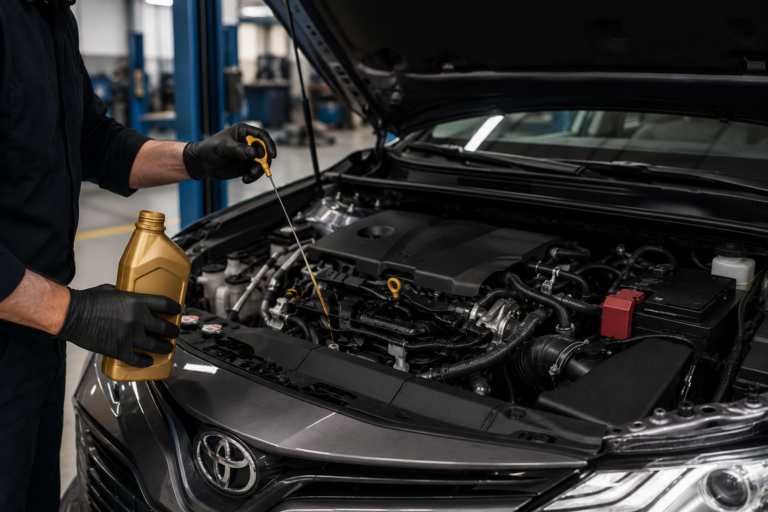
- Use the manufacturer-recommended oil alongside proper fuel; both work together for peak engine performance.
- Avoid excessive idling; it wastes fuel, increases carbon deposits, and negatively affects both MPG and emissions over time.
FAQs
What type of gas does a 2018 to 2024 Toyota Camry take?
The 2018 to 2024 Toyota Camry runs on regular unleaded 87 octane for all trims, including the V6 and hybrid; no premium fuel is needed or recommended by Toyota.
Does the Toyota Camry TRD require premium gas?
No. Despite its sport-tuned suspension and aggressive styling, the Camry TRD still officially requires regular 87 octane; premium offers no performance benefit for this engine.
Can I put 89 or 91 octane gas in my Toyota Camry?
Yes, using 89 or 91 octane won’t harm your Camry’s engine. However, since the ECU is tuned for 87 regular, you won’t gain noticeable power, fuel economy, or longevity from the upgrade.
What happens if I put diesel in a Toyota Camry by mistake?
Do not start the car; diesel in a gasoline engine causes serious fuel system damage. Have it towed immediately to a mechanic for a full fuel system flush before attempting to run the engine.
Does the Toyota Camry Hybrid use a different type of gas?
No. The Camry Hybrid still requires regular 87 octane gasoline. It is not a plug-in hybrid, so it always needs gas; the electric motor only assists; it does not replace the fuel requirement.
Conclusion
The answer is clear: every Toyota Camry, regardless of year, trim, or whether it is a hybrid, runs best on regular unleaded 87 octane gas. Stick to Toyota’s recommendation, choose a Top Tier certified station when possible, and you’ll protect your engine for the long haul without overpaying at the pump.