What PSI Should Toyota Camry Tires Be? (Check Yours Now)
This guide references Toyota owner’s manual specifications, US Department of Energy fuel economy data, and NHTSA tire safety standards.
Toyota Camry’s recommended tire pressure is 32 PSI for the majority of trims, but this single number does not tell the whole story. Correct PSI changes based on year, trim, and tire size, and wrong pressure directly affects fuel economy, tire life, and braking performance. In this guide, you will find exact PSI numbers by year and trim, seasonal adjustment tips, and the mistakes that silently lead most Camry owners toward expensive repairs.
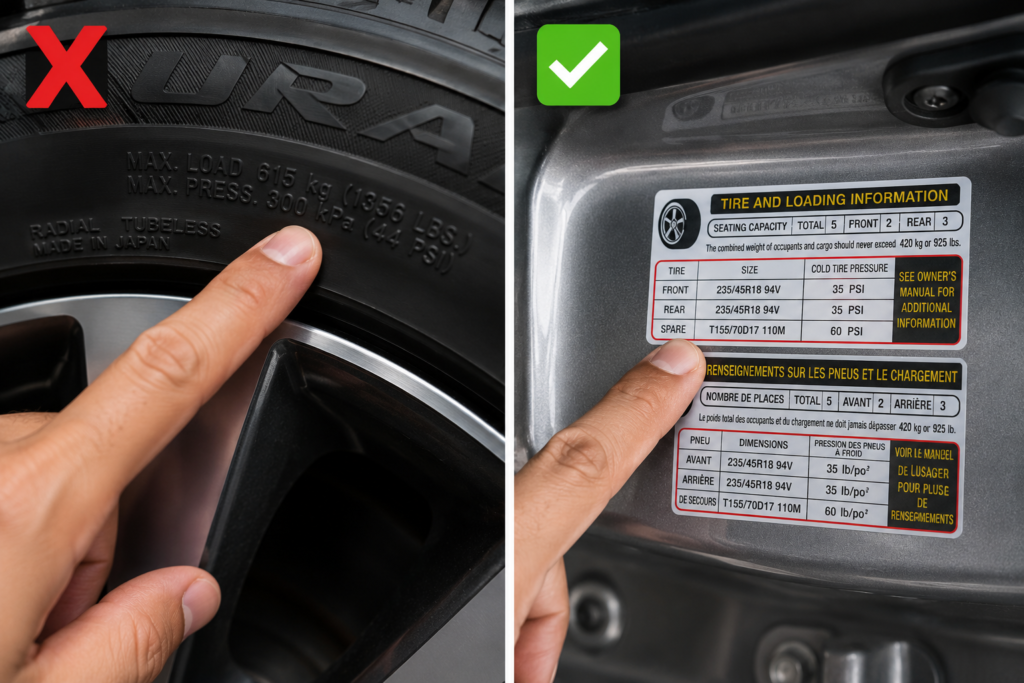
The short answer: Toyota Camry tires’ recommended PSI is 32 for standard trims. 2024 XSE/TRD trims require 35 front, 33 rear. The correct PSI is found on the door jamb sticker; do not follow the max PSI printed on the tire sidewall.
Toyota Camry Tire PSI: Exact Numbers by Year
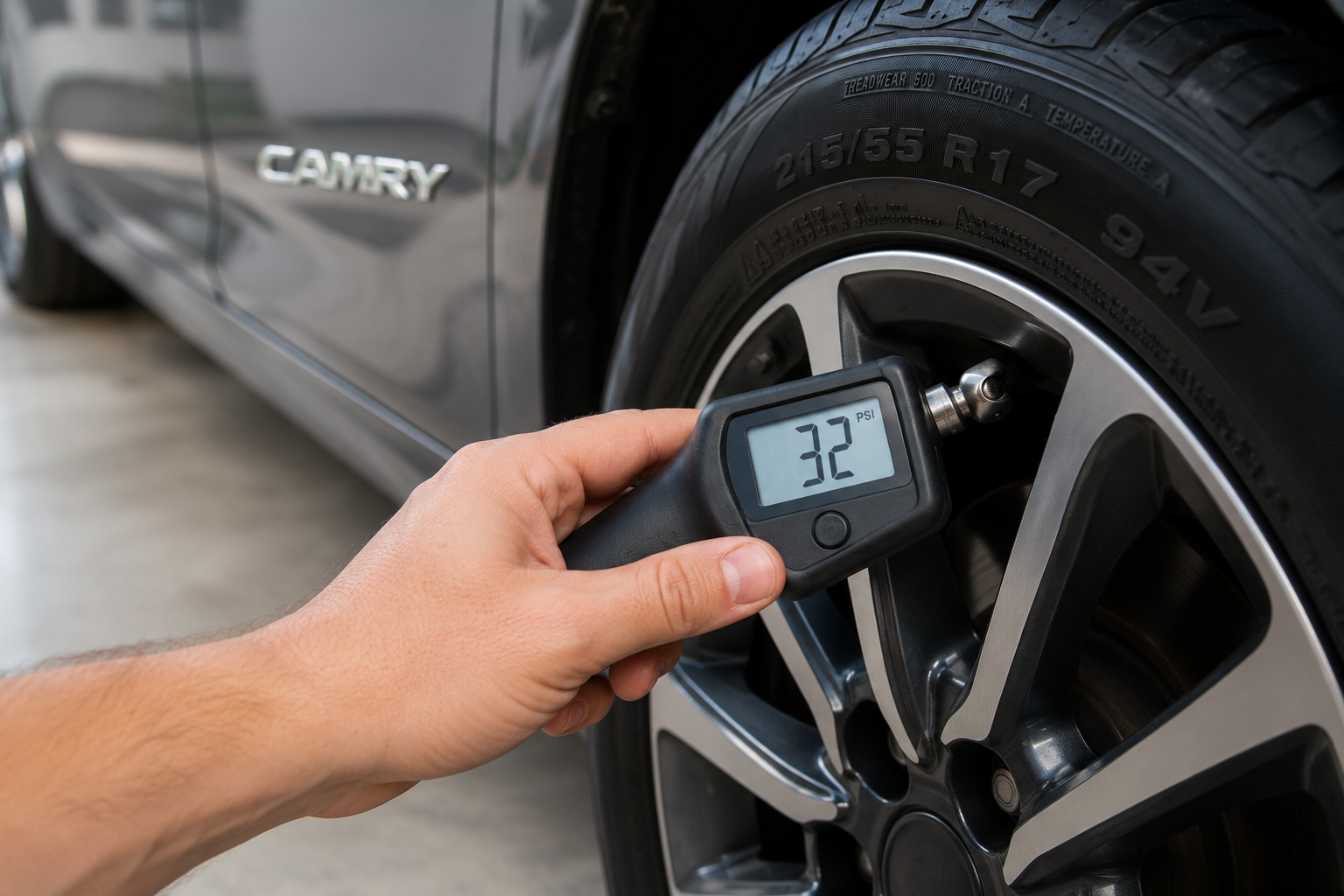
Toyota Camry’s recommended tire pressure is 32 PSI for the majority of model years, but this number changes slightly with year and trim. The most accurate number is on your driver’s door jamb sticker; it can also be found in the glove box. Manufacturer recommendation is always different from the max PSI printed on the tire sidewall; the sidewall number is the maximum safe limit, not the recommended operating pressure.
| Model Year | Front PSI | Rear PSI | Notes |
| 2024 to 2025 | 35 | 33 | XSE/TRD trims |
| 2024 to 2025 | 32 | 32 | LE/SE/XLE trims |
| 2018 to 2023 | 32 | 32 | All standard trims |
| 2015 to 2017 | 32 | 32 | All trims |
| 2012 to 2014 | 32 | 32 | All trims |
| 2007 to 2011 | 30 | 30 | V6 models: 32 PSI |
| 2002 to 2006 | 30 | 30 | Check door sticker |
Important: 2024+ XSE and TRD trims come with larger 19-inch wheels, which is why front and rear PSI differ. Always treat the door jamb sticker as the final authority.
Correct Tire Pressure for Toyota Camry (2024)
For the 2024 Toyota Camry, correct tire pressure varies by trim, and this is a common point of confusion for new owners.
LE, SE, XLE trims (17-inch wheels): 32 PSI front and rear.
XSE and TRD trims (18/19-inch wheels): 35 PSI front, 33 PSI rear. This difference exists because larger, lower-profile tires have less sidewall flex; they need slightly higher pressure for stable handling.
Hybrid models (2024 Camry Hybrid): 32 PSI front and rear. Despite the battery weight, Toyota recommends the same pressure, but rear tires carry slightly more load; double-checking rear PSI before long trips is worthwhile.
One thing 2024 owners commonly miss: if you have fitted a different size or brand of replacement tire, always use your vehicle’s door jamb sticker PSI; Toyota calculated this specifically for your car. The max PSI printed on the replacement tire’s sidewall is only that tire’s physical limit, not the recommended operating pressure.
Toyota Camry PSI Guide: Avoid These 3 Mistakes
Mistake 1: Following the PSI Printed on the Tire Sidewall
This is the most common mistake. The sidewall reads Max 44 PSI; that is the tire’s maximum safe limit, not Toyota’s recommendation. Inflating to that number overinflates the tires, accelerates center tread wear, and significantly reduces wet road grip.
Mistake 2: Checking Tires When Hot
Tire pressure rises by 4 to 6 PSI after driving because air expands with heat. If you stop at a gas station after 30 minutes of driving, the reading you get won’t be accurate. Always check PSI on cold tires, meaning the car has been parked for 3+ hours or driven less than 1 mile. If a hot check is unavoidable, subtract 4 PSI from the reading for an accurate estimate.
Mistake 3: Relying Only on Visual Inspection
A tire can operate 6 to 8 PSI below correct pressure before it visually looks flat. This looks-fine zone quietly hurts fuel economy by up to 2% and causes uneven tire wear. Without a gauge, you can never get an accurate reading; a monthly physical check is essential.
What PSI for Camry Tires? (Front vs Rear)
On standard Toyota Camry models, front and rear PSI are the same: 32 PSI on both axles. But in certain situations, the difference matters.
Read Guide: Is Toyota Camry Good in Snow?
When front and rear PSI should differ:
- XSE/TRD 2024+ trims: The factory recommendation itself is 35F/33R
- Heavy rear load: With 4 passengers and a full trunk, adding 2 PSI to the rear improves handling
- Long highway trips: Slightly higher rear PSI evens out tire wear
When same PSI is fine:
- Daily solo commuting
- Standard LE/SE/XLE trims
- Normal 2-passenger use
Front tires on the Camry carry more load; engine weight sits over the front axle, and braking force is also higher at the front. This means front tire wear is typically faster than rear, regardless of PSI. (Source: NHTSA tire wear and vehicle dynamics guidelines). This is not fixed by changing PSI; it is addressed through regular rotation every 5,000 to 7,500 miles.
Toyota Camry Tire Pressure: Full PSI Chart
Recommended PSI by tire size:
| Tire Size | Trim | PSI (F/R) |
| 205/65R16 | LE base | 32/32 |
| 215/55R17 | LE, SE, XLE | 32/32 |
| 235/45R18 | XSE, XLE V6 | 33/33 |
| 235/40R19 | XSE, TRD | 35/33 |
| 215/55R17 | Hybrid LE/SE | 32/32 |
| 235/45R18 | Hybrid XLE | 33/33 |
Where to find your tire size: The driver’s door jamb sticker lists both PSI and tire size together. It’s also on the tire sidewall in raised lettering in a format like P215/55R17.
Camry Tire PSI Too Low? Real Costs Explained
Underinflated tires are not just a safety issue; they directly affect your wallet, and most drivers miss this connection entirely.
Fuel economy: According to US Department of Energy data, every 1 PSI drop reduces overall fuel economy by 0.2%. If all 4 tires on a Camry are 5 PSI low, which is common, that is a 4% fuel economy loss. For the average Camry driver, that is $80 to $120 per year in extra fuel costs. In real-world terms, a Camry driven 400 miles weekly on tires that are 5 PSI low burns approximately 0.5 extra gallons per week a small but consistent drain that adds up over thousands of miles of driving. (Source: US Department of Energy fuel economy research.)
Tire lifespan: Significant underinflation can meaningfully reduce tire life. A set of tires that normally lasts 50,000 miles may wear out thousands of miles earlier depending on how low pressure drops and how long it stays low. On a $600 tire set, early replacement is a direct financial loss that is entirely avoidable. (Source: NHTSA tire safety guidelines.)
Brake performance: Low pressure changes the shape of the tire’s contact patch, which can increase stopping distance on wet roads. (Source: NHTSA tire safety guidelines.)
Rim damage: Severely underinflated tires (15+ PSI low) can directly damage rims in potholes. Alloy rim repair or replacement can cost $200 to $400 per wheel.
Also Read: How Many Miles Per Gallon Does a Toyota Camry Get?
Toyota Camry Tire PSI: Save Gas & Extend Life
Maintaining correct PSI is the simplest and most ignored car maintenance habit. Its direct return on investment is measurable in both areas.
Fuel savings: The standard 2024 Camry gets approximately 28 MPG city / 39 MPG highway, while the 2024 Camry Hybrid is EPA-rated at 43 MPG city / 44 MPG highway (FWD). In both cases, properly inflated tires help achieve these numbers. With 4 PSI low, real-world mileage can drop 1.5 to 2 MPG; that is $3 to $5 extra per tank fill.
Practical steps to extend tire life:
- Check cold PSI once a month 5 minutes of work
- Check after temperature changes: every 10°F drop in temperature reduces PSI by approximately 1 PSI; critical in winter
- Nitrogen fill’s real-world benefit is minimal for regular commuters; the pressure difference versus regular air is only 1 to 2 PSI per month. Its actual benefit is in racetrack use or extreme temperature swings like desert or mountain driving. For daily Camry drivers, monthly regular air checks are more effective than nitrogen
- Rotating tires every 5,000 to 7,500 miles, even with correct PSI, prevents uneven wear
Seasonal note: When temperatures exceed 45°C in summer, tire pressure can naturally rise by 3 to 5 PSI. Stay at the recommended PSI; do not release pressure in hot weather, because once the car cools down, pressure returns to normal on its own.
Right PSI for Toyota Camry Tires (All Models)
| Generation | Years | Standard PSI | Sport Trim PSI |
| 9th Gen | 2024 to present | 32/32 | 35/33 |
| 8th Gen | 2018 to 2023 | 32/32 | 32/32 (33/33 for V6 with 18″ wheels, 2018 to 2021 only)* |
| 7th Gen | 2012 to 2017 | 32/32 | 32/32 |
| 6th Gen | 2007 to 2011 | 30/30 | 32/32 |
| 5th Gen | 2002 to 2006 | 30/30 | 30/30 |
Sport trim PSI applies only to trims equipped with 18-inch or larger wheels. Verify with your specific door jamb sticker; PSI varies by wheel size, not trim name alone.
For Camry owners with aftermarket tires: If you have fitted tires of a different size than stock, the door jamb sticker PSI may not directly apply. In this case, follow the replacement tire manufacturer’s specific PSI recommendation, which is printed on the tire sidewall as a range. When in doubt, consult a certified tire technician; incorrect PSI on non-stock tires is a safety risk.
Toyota Camry Tire Pressure: Warning Signs + Fix
Warning Signs Not to Miss:
- TPMS light on: The tire icon lighting up on your dashboard means one or more tires are 25% or more underinflated. On the Camry, this triggers between 24 and 26 PSI when the recommended pressure is 32 PSI. Federal law mandates a warning at 25% drop, but the exact trigger point varies due to ±1–2 PSI sensor variance. By the time the light comes on, tires are already significantly underperforming
- Heavy or vague steering feel: With underinflation, the tire sidewall flexes more, dulling steering response
- Vibration at highway speed: Overinflation makes the tire ride on its center, creating vibration
- Uneven tread wear: Center wear means overinflated, edge wear means underinflated; both are fixable if caught early
Fix Step by Step:
- Car should be parked for 3+ hours (cold tires)
- Remove valve stem cap
- Note current PSI with a gauge
- Confirm recommended PSI from door jamb sticker
- Add or release air accordingly; adjust in 2 PSI increments
- Replace cap
- On most 2010 and newer Camry models, the TPMS light resets automatically when tires reach correct pressure, usually after 10 minutes of driving. Older models may require a manual reset; check your owner’s manual
Camry Tire PSI: What Dealers Won’t Tell You
Dealers and quick lube shops rarely share three things that actually affect your tires and wallet.
1. TPMS Light Is a Late Warning
TPMS triggers at 25% underinflation. By the time the light comes on, your tires are already significantly low, and some wear damage has already occurred. Monthly manual checks are more effective than depending on TPMS.
2. The Math on Free Nitrogen Fills
Nitrogen fills are beneficial because pressure stays more stable, but if a tire runs low and nitrogen is not available, filling with regular air is completely safe. Mixing air and nitrogen does no harm to tires. Regular air in properly maintained tires outperforms nitrogen in poorly maintained ones.
3. PSI Is Not Checked at Oil Changes Unless You Ask
Most lube shops check tires visually, not with a gauge. Tires look good does not mean actual PSI was checked. At every oil change, specifically say: Please check PSI with a gauge and give me the exact numbers. A properly checked Camry will get a reading like 31 PSI front left, 30 PSI front right, 32 PSI rear both. Without that level of specificity, tires checked means nothing. If all four tires come back at the same number like 32/32/32/32 without any variation, that is a sign it was assumed, not measured. Any shop that refuses or cannot give exact numbers is not checking properly.
FAQs
Is 32 PSI safe for all Toyota Camry trims?
32 PSI is safe and correct for standard LE, SE, and XLE trims. XSE and TRD trims require 35 PSI front and 33 PSI rear due to larger wheels.
Does Toyota Camry tire pressure affect fuel economy?
Yes. According to US Department of Energy data, every 1 PSI drop reduces fuel economy by 0.2%. With tires 5 PSI low, Camry owners pay $80 to $120 in extra fuel costs per year without realizing it.
Should Toyota Camry front and rear tire pressure be different?
On standard trims, both front and rear are 32 PSI. Only 2024+ XSE and TRD trims have a different factory recommendation: 35 PSI front, 33 PSI rear.
Can I use regular air instead of nitrogen in my Camry tires?
Yes, completely safe. Mixing regular air and nitrogen does no harm to tires. Properly maintained tires with regular air outperform poorly maintained tires filled with nitrogen.
Does cold weather lower Toyota Camry tire pressure automatically?
Yes. Every 10°F temperature drop reduces PSI by approximately 1 PSI. In winter, Camry tires can drop 3 to 4 PSI with no leak present; monthly checks are essential.
Conclusion
Maintaining correct tire pressure is Toyota Camry’s simplest and highest-return maintenance habit. Running at 32 PSI means better fuel economy, longer tire life, and safer braking three benefits from one habit. Monthly cold checks, seasonal adjustments, and treating the door jamb sticker as the final authority are all it takes. A $10 tire gauge and 5 minutes monthly: this investment protects you from $250 to $400 in rotor repair costs, $150+ in early tire replacement, and $100+ in annual fuel waste. The Toyota Camry is a reliable car; correct PSI is what lets that reliability actually deliver.