Is the Toyota Camry Good in Snow? (Before You Buy)
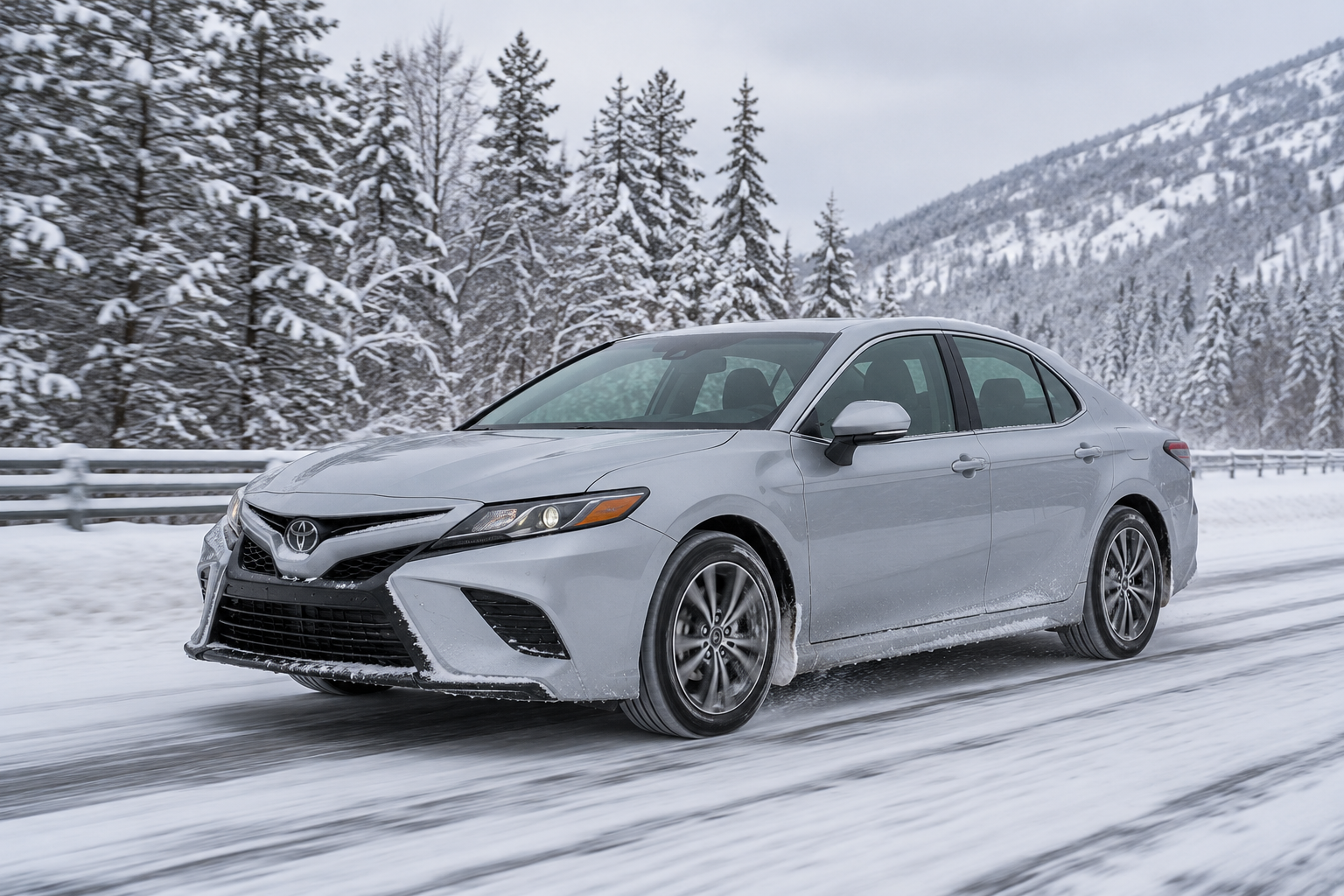
Yes, the Toyota Camry can be good in snow, but the right version matters.
FWD Camry models from 2015 to 2019: Fine for light snow when equipped with good all-season tires or, ideally, winter tires. They struggle more on steep hills, ice, and unplowed roads.
AWD Camry models from 2020 to 2024: Better for snowy starts and slippery roads because Toyota’s Dynamic Torque Control AWD can send power to the rear wheels when the front tires slip.
AWD Camry models from 2025 to 2026: The strongest Camry option for snow because the hybrid Electronic On-Demand AWD system uses a dedicated rear electric motor for extra traction when needed.
A FWD Camry with winter tires is enough for occasional snow. If you live in a snow-belt state or deal with regular winter storms, an AWD Camry is the better choice.
If you live somewhere that gets real winters, picking the right car matters more than most people admit. The Toyota Camry is one of America’s best-known midsize sedans, but snow performance was never its main selling point. That changed for modern Camry buyers in 2020, when Toyota brought AWD back to the Camry for the first time since the early 1990s.
Now the question is not just whether the Camry survives winter. It is which version handles snow confidently, which model years are worth buying, and what you can do with a FWD Camry to make it genuinely winter-capable.
This guide breaks down snow performance across FWD and AWD Camry models from 2015 through 2026 using official Toyota drivetrain information, specification data, tire guidance, and common winter-driving feedback from Camry owners.
Is the Toyota Camry FWD or AWD?
Most Toyota Camrys are front-wheel drive. For the 2015 to 2019 model years, the Camry was FWD only. AWD returned for the 2020 model year on select four-cylinder gas trims, and the 2025 redesign made the Camry hybrid-only while keeping available AWD on multiple trims.
| Model Years | Drivetrain Availability | Snow Capability |
| 2015 to 2017 Camry | FWD only | Fair with winter tires |
| 2018 to 2019 Camry | FWD only | Better safety tech, still tire-dependent |
| 2020 to 2024 Camry gas 4-cylinder | FWD or available AWD on select trims | Good with AWD |
| 2020 to 2024 Camry V6 / TRD / Hybrid | FWD only | Moderate |
| 2025 to 2026 Camry Hybrid | FWD or available AWD | Best Camry setup for snow |
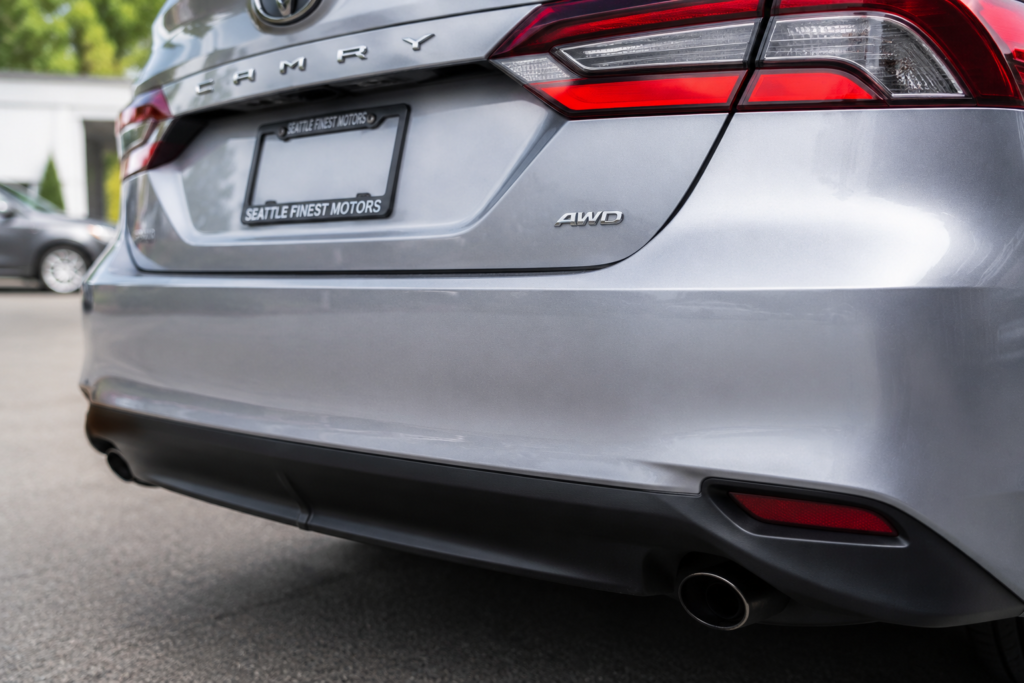
If you are shopping used, do not assume every 2020 or newer Camry has AWD. Many are still FWD, so check the window sticker, VIN details, or rear badging before buying.
Not sure if your specific Camry trim actually has AWD? This breaks down every version so you do not guess wrong before buying.
When Did Toyota Add AWD to the Camry?
Toyota brought AWD back to the Camry for the 2020 model year. For 2020–2024, Camry AWD used Toyota’s Dynamic Torque Control AWD system, which could send up to 50% of engine torque to the rear wheels when extra traction was needed. It was available on select four-cylinder trims such as LE, SE, XLE, XSE and, in some years, SE Nightshade.
The system changed again for 2025. Starting with the redesigned 2025 Camry, Toyota made the Camry exclusively hybrid. It offered Electronic On-Demand AWD, which uses a dedicated rear electric motor to power the rear wheels when needed.
How Does the Toyota Camry Perform in Light Snow?
In light snow, one to three inches on cleared roads, the FWD Camry performs well enough for most daily drivers. Traction control kicks in quickly, acceleration feels controlled, and the car does not feel nervous on packed snow. Newer Camrys also benefit from updated safety and driver-assistance features, but snow performance still depends mostly on tires, speed, road conditions, and drivetrain.
That said, light snow on hills is where FWD Camrys start showing limits. In real-world winter driving, the most common FWD Camry complaint is wheel spin when starting from a stop on snowy hills. This is especially noticeable with worn all-season tires. Switching to proper winter tires usually makes a larger difference than most drivers expect.
Real Owner Experiences in Winter Conditions
Camry owners in snow states like Wisconsin, Pennsylvania, and Minnesota report a consistent pattern. FWD models manage light snow and treated roads without drama, but icy hills and unplowed side streets expose the limits quickly. AWD owners describe noticeably more confidence, less wheel spin on cold starts, steadier straight-line driving, and fewer anxious moments on untreated roads.
How Does the Toyota Camry Handle Heavy Snow?
Heavy snow four inches or more, especially unplowed, is where the FWD Camry genuinely struggles. The car sits low, the front wheels have to handle everything, and recent Camry models sit low for winter use, with the 2024 Camry listed at 5.7 inches of ground clearance. It gets through, but it requires careful throttle, slow speeds, and ideally winter tires underneath.
The AWD Camry does meaningfully better in heavy snow. On 2020 to 2024 AWD models, Toyota’s Dynamic Torque Control AWD can send torque to the rear wheels when extra traction is needed. On 2025 to 2026 AWD Hybrid models, a rear electric motor adds traction when the system detects the need for rear-wheel power. But even AWD cannot fully compensate for that 5.7-inch clearance if snow is packed deep enough to drag the undercarriage; neither drivetrain saves you.
FWD Camry Limitations in Deep Snow
The FWD Camry has three real problems in deep snow:
- Ground clearance: Recent Camry models have sedan-level clearance, so deep, wet, or packed snow can drag under the car sooner than it would in an SUV or crossover.
- Weight distribution: Front-heavy layout puts too much demand on two tires doing all the work
- Cold starts on inclines: Wheel spin on uphill starts is the most common complaint from owners in mountain states like Colorado and Utah
Does the Toyota Camry Have Snow-Specific Safety Features?
The Camry comes well-equipped with stability tech. Even base FWD models have more than most people realize.
| Feature | What It Helps With | Availability |
| Traction Control | Reduces wheel spin during acceleration | All modern Camrys |
| Vehicle Stability Control | Helps correct skids and loss of control | All modern Camrys |
| ABS | Helps prevent wheel lockup under braking | All modern Camrys |
| Toyota Safety Sense-P | Pre-collision, lane departure, radar cruise, auto high beams | Standard on 2018 Camry |
| Toyota Safety Sense 2.5+ | Updated driver-assistance suite | 2021+ Camry |
| Dynamic Torque Control AWD | Sends torque rearward when front slip is detected | 2020 to 2024 select gas 4-cylinder trims |
| Electronic On-Demand AWD | Uses rear electric motor for added traction | 2025 to 2026 AWD Camry Hybrid |
Toyota Safety Sense can help reduce collision risk, but it does not create traction. In snow, tires and speed control still matter more than driver-assistance technology.
Does the Toyota Camry Have Snow Mode?
Some Toyota models have a dedicated Snow Mode, but you should not buy a Camry based on Snow Mode alone. For Camry snow performance, the bigger factors are drivetrain, tires, ground clearance, and driver input.
For 2020 to 2024 AWD Camrys, Toyota’s key snow advantage is the Dynamic Torque Control AWD system, which can automatically send torque to the rear wheels when the front tires slip. For 2025 to 2026 AWD Camrys, Toyota uses Electronic On-Demand AWD with a rear electric motor that automatically adds rear-wheel traction when needed.
Even if a specific Camry trim lists a winter or snow-related drive mode, it does not replace winter tires. Snow Mode can soften throttle response, but tires determine how well the car stops, turns, and grips on ice.
Toyota Camry AWD vs FWD in Snow: Which Should You Buy?
If you live somewhere with regular snow, freezing rain, or steep winter roads, the AWD Camry is the better choice. The FWD Camry can work well with winter tires, but AWD makes slippery starts, snowy intersections, and unplowed side streets easier to handle.
That said, AWD does not make the Camry unstoppable. The car still has sedan-level ground clearance, and AWD does not shorten stopping distances on ice. For the best winter setup, choose AWD and install a full set of winter tires.
| Factor | FWD Camry | AWD Camry |
| Best for | Light snow, treated roads, mild winter climates | Regular snow, icy starts, snow-belt commuting |
| Main advantage | Lower cost, better fuel economy | Better traction when accelerating |
| Main weakness | Wheel spin on hills and icy starts | Still limited by tires and ground clearance |
| Winter tire need | Strongly recommended | Still recommended for serious winter driving |
| Deep snow ability | Limited | Better, but still not SUV-level |
| Best model years | 2018 to 2024 FWD with winter tires | 2020 to 2026 AWD |
Is AWD Worth the Extra Cost for Snow?
For most snow-state buyers, yes. The $1,400 price difference is less than one set of quality winter tires. AWD also holds slightly better resale value in northern states where buyers specifically look for it. If you live somewhere that gets maybe one or two light snow events per year, FWD with winter tires is genuinely enough and saves you money upfront.
Do Winter Tires Make a Big Difference on a Camry?
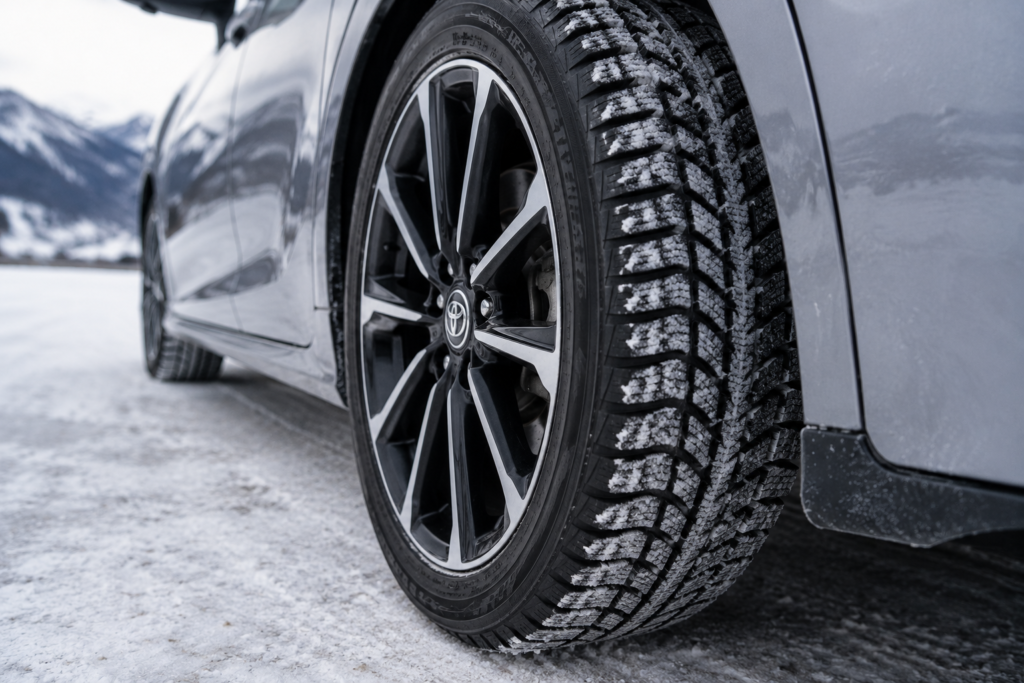
Bigger than most people expect. A FWD Camry on quality winter tires outperforms an AWD Camry on all-season tires in most real-world winter conditions. Tires are the single biggest variable in winter driving, more than drivetrain, more than ground clearance.
This is why winter tires matter so much. AWD helps a car get moving, but it does not automatically improve braking or cornering. Tire makers and safety organizations consistently emphasize that winter tires improve cold-weather grip, especially on snow and ice. Michelin specifically notes that AWD helps acceleration but does not improve braking or cornering.
Can Winter Tires Replace AWD on a Camry?
For light to moderate snow, yes, winter tires on a FWD Camry are highly effective and significantly cheaper than buying an AWD trim. The honest limitation is heavy, unplowed snow and sustained sub-freezing temperatures over long winters. In those conditions, AWD plus winter tires is the strongest combination. Winter tires alone cannot fix the ground clearance issue, and they cannot match AWD for deep snow starts on steep inclines.
How Does the Toyota Camry Compare to Competitors in Snow?
| Car | Drivetrain | Snow Performance | Current Status |
| Toyota Camry AWD | Available AWD | Good | Current |
| Nissan Altima AWD | Available AWD | Good | Current |
| Honda Accord | FWD only | Moderate | Current |
| Subaru Legacy | Standard AWD | Excellent | Used / 2025 final model year |
| Mazda6 | FWD only | Moderate | Used only |
The Subaru Legacy is the strongest snow sedan in this group because it came standard with AWD, but it is now a used-car or remaining-inventory option after Subaru announced the end of Legacy production after the 2025 model year. Among current midsize sedans, the Camry AWD and Nissan Altima AWD are the most relevant snow-friendly choices. The Honda Accord remains an excellent sedan overall, but it does not offer AWD.
Nissan currently lists the 2026 Altima with available Intelligent AWD, while Honda’s 2026 Accord page does not present AWD as an option.
Which Toyota Camry Year Is Best for Snow Driving?
The best Camry for snow depends on your budget and how severe your winters are.
| Model Years | Snow Verdict | Why |
| 2025 to 2026 AWD Hybrid | Best overall | Newest AWD system, hybrid-only lineup, rear electric motor |
| 2020 to 2024 AWD gas | Best used value | AWD available, proven four-cylinder setup |
| 2018 to 2019 FWD | Best budget FWD choice | Standard Toyota Safety Sense-P, good with winter tires |
| 2015 to 2017 FWD | Acceptable in mild snow | Reliable, but older safety tech |
| Pre-2015 | Not ideal for regular snow | Older tech, age, mileage, and tire condition become bigger concerns |
If buying used specifically for snow, look first for a 2020 to 2024 AWD four-cylinder Camry or a 2025 to 2026 AWD Hybrid. Always confirm AWD before buying because many Camrys from these years are still FWD.
Picking the right year for snow also means avoiding the wrong ones; some Camry model years have known issues that show up worse in cold weather conditions.
Is the Toyota Camry a Good Daily Driver in Snowy Climates?
When people ask whether the Toyota Camry is good in snow as a year-round daily driver, the honest answer depends on which version you have and where you live.
In moderate snow climates, think Nashville, Kansas City, or northern Virginia, a FWD Camry with decent tires handles winter without drama. In genuine snow-belt cities like Buffalo, Minneapolis, or Denver, the AWD Camry is worth every dollar of the upgrade. It removes the anxiety of morning starts, handles unplowed neighborhood roads, and gives you real confidence on the highway in deteriorating conditions.
For anyone commuting daily through a real winter, the AWD Camry earns its keep. For occasional snow, the FWD version with winter tires is a smarter budget decision.
Snow performance is only part of the daily driver equation; here is the full picture on how reliable the Camry actually is year-round.
Toyota Camry Snow Driving Tips
A Camry can handle winter better if it is set up correctly. Before snow season, check tire tread depth, tire pressure, battery condition, wiper blades, washer fluid, and brakes. In freezing weather, tires lose pressure faster, and worn all-season tires can make even an AWD car feel unstable.
For FWD Camrys, use gentle throttle when starting from a stop. Avoid sudden steering inputs, leave extra braking distance, and do not rely on traction control to fix poor tires. For AWD Camrys, remember that AWD mainly helps you accelerate. It does not make the car stop faster on ice.
The best winter setup is simple: four quality winter tires, conservative speed, smooth inputs, and enough ground clearance to avoid plowing through deep snow.
FAQs
Does the Toyota Camry AWD work well in snow?
Yes. The AWD Camry works well in light to moderate snow, especially when equipped with good tires. The 2020 to 2024 AWD system can send torque to the rear wheels when the front tires slip, while the 2025 to 2026 AWD Hybrid uses a rear electric motor for extra traction.
Is a FWD Toyota Camry good in snow?
A FWD Camry is good enough for light snow and treated roads, especially with winter tires. It is less confident on icy hills, deep snow, and unplowed roads.
What year did the Toyota Camry get AWD?
Toyota brought AWD back to the Camry for the 2020 model year. The 2020 to 2024 AWD Camry used Dynamic Torque Control AWD, while 2025 to 2026 AWD Camrys use Electronic On-Demand AWD.
Does AWD replace winter tires on a Camry?
No. AWD helps the car get moving, but winter tires help with braking, steering, and grip. For serious winter driving, winter tires matter more than many drivers realize.
Which Camry is best for snow?
The best Camry for snow is a 2025 to 2026 AWD Hybrid or a 2020 to 2024 AWD gas model with winter tires. For budget buyers, a 2018 to 2019 FWD Camry with winter tires is a solid option.
Conclusion
The Toyota Camry can be a good snow car, but the right setup matters. FWD Camrys handle light snow well when fitted with proper tires, but they are limited on steep hills, ice, and deep unplowed roads. AWD Camrys are better for snow-belt drivers because they add traction when starting and accelerating on slippery surfaces.
For the strongest winter setup, choose a 2020 to 2024 AWD Camry or a 2025 to 2026 AWD Hybrid and pair it with four winter tires. That combination gives the Camry enough winter confidence for most sedan drivers, while still keeping the comfort, reliability, and fuel economy that make the Camry popular year-round.