How to Turn On Traction Control in a Toyota Camry (All Model Years)
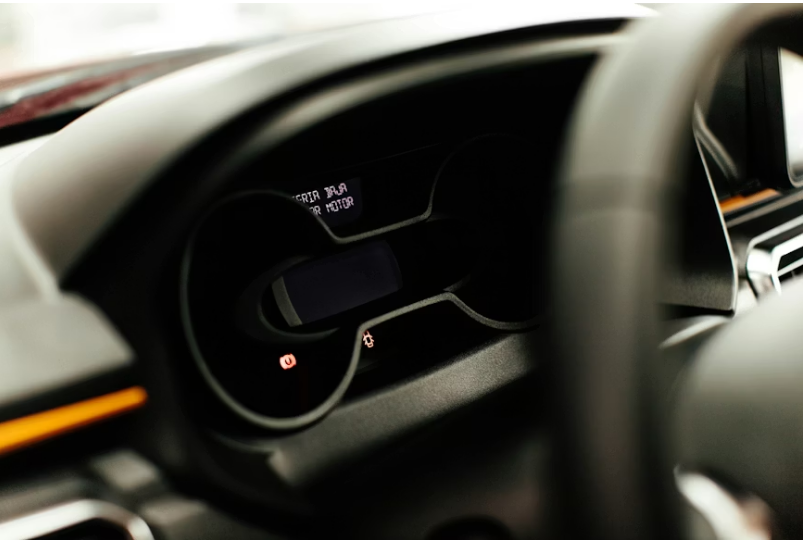
If your Toyota Camry dashboard suddenly shows TRAC OFF and you have no idea what happened or how to fix it, you are not alone. This is one of the most common questions Toyota Camry owners search for, and in most cases, the fix takes less than 30 seconds.
The frustrating part is that most drivers who see this warning are not dealing with a serious mechanical problem. They accidentally pressed a button, hit a slippery patch of road, or the system temporarily disabled itself during wheel slip. But because the warning light looks alarming on the dashboard, many owners immediately assume something is wrong with their transmission or engine.
This guide explains exactly how to turn traction control back on in every Toyota Camry generation from 2007 to 2026, why the TRAC OFF light appears in the first place, what the system actually does, and when the warning light signals a real problem that needs attention.
Where Is the Traction Control Button on a Toyota Camry?
Before you can turn traction control back on, you need to find the button, and Toyota moved it between generations, which causes a lot of confusion.
On most Camry models from 2007 through 2011, the TRAC OFF button sits below the steering wheel on the lower dashboard panel, close to the driver’s left knee. It is easy to press accidentally, especially when reaching for something in the footwell or cleaning around the pedals.
From 2012 through 2017, Toyota moved the button closer to the gear shifter area in the center console. This placement made it more accessible but also easier to press unintentionally while adjusting the gear selector or reaching for the cup holder.
From 2018 onward through the current 2026 models, the button sits on the lower dashboard console, integrated with other Toyota Safety Sense controls. The labeling is clearer in newer models, but the button is still easy to miss.
Button Location By Generation
| Camry Model Years | Button Location | System Name |
| 2007 to 2011 | Below the steering wheel | TRAC / VSC |
| 2012 to 2017 | Near the gear shifter area | TRAC Control |
| 2018 to 2026 | Lower dashboard console | Toyota Safety Sense |
Practical tip: If you cannot find the button, look for a car icon with wavy lines underneath it. That is Toyota’s universal symbol for traction control across all Camry generations.
How to Turn Traction Control Back On in a Toyota Camry
In the majority of cases, turning traction control back on is a simple one-step process.
Method 1 Press the Button Once: Locate the TRAC OFF button and press it once. In most Camry models, this immediately reactivates the traction control system, and the dashboard warning light disappears within a few seconds.
Method 2 Restart the Engine: If pressing the button does not work, turn the engine completely off, wait 10 seconds, and restart. Toyota Camry traction control is designed to automatically reactivate when the ignition is cycled. This is intentional. Toyota treats traction control as a primary safety feature and wants it active by default every time you drive.
Method 3 Drive Forward Slowly: On some older Camry models from 2007 through 2011, the system resets itself after the vehicle moves forward at low speed for a few seconds. If the light appeared after a wheel spin on a slippery surface, this is often all that is needed.
When these methods do not work: If the TRAC OFF light stays on after trying all three methods, the system is telling you there is an underlying fault, not just a button press. In that case, the light is a symptom, not the problem itself.
Why Did the TRAC OFF Light Come On?
Understanding why the light appeared helps you decide whether it is a quick fix or something that needs a mechanic.
Reason 1: Accidental Button Press (Most Common)
This accounts for the majority of TRAC OFF cases. The button is positioned in an area that drivers frequently brush against when cleaning the dashboard, reaching across the center console, or simply shifting their driving position. If you cannot remember pressing it, you probably did it without realizing.
Fix: Press the button once. Done.
Reason 2: Wheel Slip on Slippery Surface
When one or more tires lose grip and spin faster than the others, the traction control system engages aggressively to regain control. In some situations, particularly on deep snow, loose gravel, or steep hills, the system will temporarily disable itself to allow wheel movement when the electronic intervention is making the situation worse rather than better.
Fix: Once you are back on the normal road surface, restart the engine or press the button.
Reason 3: Weak Battery Voltage
This one surprises many owners. A battery that is losing capacity, common in cold weather or in vehicles over 4 to 5 years old, can send inconsistent voltage to Toyota’s electronic systems. The traction control module interprets this inconsistency as a sensor fault and triggers the TRAC OFF warning as a precaution.
Fix: Have your battery tested. A battery health check costs nothing at most auto parts stores. If the battery is weak, replacing it often clears the traction control warning permanently.
Read Our Guide On: How Long Do Toyota Camry Hybrid Batteries Last?
Reason 4: Faulty Wheel Speed Sensor
The traction control system depends on wheel speed sensors to monitor how fast each tire is rotating. If one sensor is damaged, dirty, or sending incorrect data, the system cannot do its job and disables itself.
Wheel speed sensor problems are more common after driving through deep puddles, after a curb impact, or on high-mileage vehicles where the sensor has simply worn out. The TRAC OFF warning often appears alongside the ABS warning light; in these cases, both systems share the same sensors.
Fix: A mechanic can scan for fault codes in under 15 minutes. Sensor replacement on a Camry typically costs between $150 and $300, depending on which wheel and whether you use a dealer or an independent shop.
Reason 5: Steering Angle Sensor Issue
The steering angle sensor tells the traction and stability control systems which direction the steering wheel is pointing. If this sensor loses calibration, which can happen after wheel alignment work, after a suspension impact, or sometimes on its own, the TRAC OFF and VSC lights may appear together.
Fix: A proper wheel alignment usually includes recalibration of the steering angle sensor. If the warning appeared after recent alignment work, go back to the shop and ask them to recalibrate.
What Does Toyota Camry Traction Control Actually Do?
Many Camry owners know traction control exists, but do not fully understand what it does, which is why the warning light causes so much confusion.
Here is the simple explanation: your Camry’s traction control system continuously monitors the rotational speed of all four wheels using the same sensors your ABS relies on. Under normal driving conditions, all four wheels should spin at roughly the same speed.
When one tire starts spinning significantly faster than the others, which happens when it loses grip on a slippery surface, the system has two tools it can use:
Tool 1: Reduce engine power: The system briefly cuts throttle response to reduce the torque going to the spinning wheel. This is why some drivers describe a momentary hesitation or flat spot in acceleration during wet weather; they are feeling traction control doing its job.
Tool 2 Apply selective braking: The system can apply the brake on just the spinning wheel to slow it down and transfer power to the wheels that still have grip.
Both actions happen in fractions of a second and are completely transparent to the driver in most situations. You may feel a slight shudder or see the TRAC light flash briefly, which is normal and means the system is actively working.
What Traction Control Does in Different Situations?
| Driving Situation | What the System Does | What You Feel |
| Wet roads | Reduces wheel spin automatically | Brief throttle reduction |
| Sharp acceleration | Controls tire slip from a standing start | Slight hesitation |
| Gravel surfaces | Improves grip by managing spin | Smooth power delivery |
| Snow or ice | Limits wheel spin to maintain direction | Reduced acceleration |
| Highway lane change | Works with VSC to maintain stability | Minimal, mostly invisible |
TRAC vs VSC: What Is the Difference?
Toyota Camry owners often see both TRAC and VSC mentioned on their dashboard or in their owner’s manual without a clear explanation of how they differ.
TRAC (Traction Control) is specifically designed to prevent wheel spin during acceleration. It operates primarily when the car is moving forward, and one or more drive wheels begin to slip.
VSC (Vehicle Stability Control) works during cornering and directional changes. If the car begins to understeer (pushing wide in a corner) or oversteer (rear end stepping out), VSC applies individual wheel brakes and reduces engine power to bring the car back in line with where the steering wheel is pointed.
In practical terms, TRAC protects you during straight-line acceleration in slippery conditions. VSC protects you when the car begins to deviate from your intended path during cornering.
| System | Main Function | When It Activates |
| TRAC | Prevents wheel spin | Acceleration on slippery surfaces |
| VSC | Prevents skidding | Cornering, sudden direction changes |
| ABS | Prevents wheel lock | During hard braking |
Toyota designs all three systems to work together. This is also why a single sensor failure, particularly a wheel speed sensor, can trigger warning lights for all three systems simultaneously.
Should You Ever Turn Traction Control Off Intentionally?
For normal daily driving, there is almost no reason to turn traction control off. The system improves safety in rain, reduces tire wear from spinning, and helps maintain control in unexpected situations.
However, there are specific situations where temporarily disabling traction control is actually the right decision:
Getting unstuck from deep snow or mud: Traction control can work against you here. When a tire is buried and needs to spin to dig out, the system interprets that spinning as wheel slip and cuts power, which is the opposite of what you need. Turning TRAC OFF temporarily allows the tire to spin and potentially dig its way to solid ground.
Sand driving: Similar to deep snow, controlled wheel spin can help in soft sand where the system would otherwise cut power at the wrong moment.
Track driving: Some drivers prefer to have full throttle control at a track day. This is a legitimate use case, though it requires skill and experience to manage without the safety net.
For any of these situations, remember that most Camry models automatically turn traction control back on when you restart the engine, so you do not risk forgetting to reactivate it for normal driving.
How Toyota Improved Traction Control From 2020 to 2026
If you drive a newer Camry, you may notice that traction control feels less intrusive than on older models. That is not your imagination.
Toyota significantly updated the traction and stability control software in the 2020 Camry redesign and continued refining it through the 2025 and 2026 model years. The newer system uses faster sensor communication and more sophisticated intervention logic, meaning it can apply smaller, more precise corrections rather than the more noticeable power cuts that older systems used.
The 2025 Camry, which Toyota redesigned around a hybrid-first platform, integrates traction control more deeply with the hybrid powertrain management system. The electric motor’s ability to modulate torque almost instantly gives the stability system faster and more precise control than a purely combustion-based system can provide.
Practical result: newer Camry owners tend to report fewer noticeable traction control interventions, even in similar driving conditions, the system does its job more quietly.
How to Fix the TRAC OFF Light Step by Step
If your TRAC OFF light is on right now, work through these steps in order:
Step 1: Press the TRAC OFF button once and wait 5 seconds. If the light disappears, you are done accidental press was the cause.
Step 2: Turn the engine off completely, wait 15 seconds, and restart. If the light disappears, a temporary sensor or voltage issue has cleared itself.
Step 3: Check your tire pressure. Uneven tire pressure changes wheel speed readings and can confuse the traction control system. Toyota’s system is particularly sensitive to differences between tires. Inflate all four tires to the recommended PSI shown on the sticker inside your driver’s door.
Step 4: Check battery voltage. A voltmeter or a free battery test at an auto parts store will tell you if battery health is the cause. A healthy battery should read 12.4 to 12.7 volts at rest.
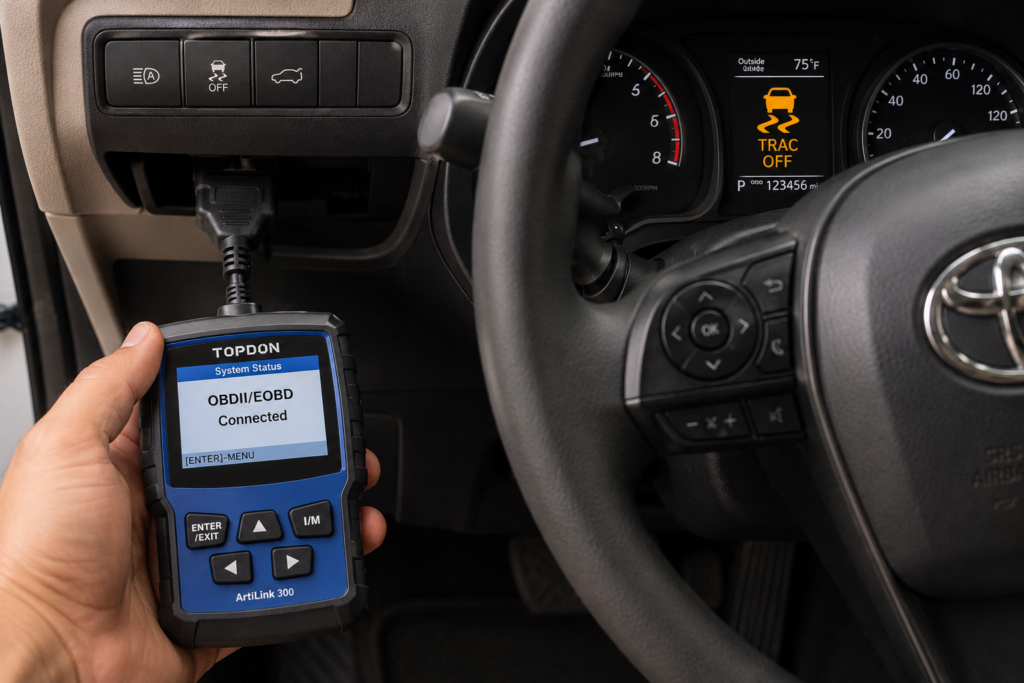
Step 5: Look for other warning lights. If the ABS light, VSC light, or check engine light is also on, there is likely a sensor fault involved. At this point, an OBD-II scanner will pull the specific fault code and tell you exactly which sensor or system triggered the warning.
Step 6: Visit a mechanic for diagnosis. If none of the above steps resolve the warning, a professional diagnostic scan will identify the specific fault. Common culprits at this stage are wheel speed sensors, the steering angle sensor, or, in rare cases, the ABS module itself.
Warning Signs That Mean the Problem Is Serious
Most TRAC OFF situations are minor. But there are specific combinations of warning lights and symptoms that suggest a real safety issue:
- TRAC OFF + ABS light together: Almost always indicates a wheel speed sensor fault. Drive carefully and get it checked promptly. Your braking distances are checked promptly.
- TRAC OFF + VSC light + Check Engine light: This combination usually points to a more significant electronic fault. Do not ignore this combination.
- TRAC OFF during normal dry road driving with no prior slip: If the system is disabling itself without any slippery conditions or button presses, a sensor is almost certainly involved.
- Traction control warning that returns every time you restart: A persistent warning that will not clear permanently after restarting indicates an active fault code stored in the system.
Frequently Asked Questions
Can you turn traction control back on while the car is moving?
Yes. Pressing the TRAC OFF button while driving will reactivate the system immediately on all Camry models from 2007 onward. You do not need to stop the car.
Why does the TRAC OFF light keep coming back after I clear it?
If the light returns consistently after each restart or clearing, the system has an active fault code stored. A simple restart clears temporary warnings, but it cannot clear a stored fault. You need an OBD-II scanner or a mechanic to read and address the underlying code.
Does traction control affect fuel economy?
In normal driving conditions, no. The system only activates when wheel slip occurs. If your Camry is regularly engaging traction control during normal acceleration, that may indicate tire wear or pressure issues worth addressing.
Can mismatched tires trigger TRAC OFF?
Yes. Toyota’s wheel speed sensors are sensitive enough to detect differences in tire diameter. If one tire is significantly more worn than the others, or if you have mismatched tire sizes on the same axle, the system may interpret the speed difference as wheel slip and activate.
Is it safe to drive a Camry with TRAC OFF on during rain?
You can drive, but your tires are more likely to spin on wet surfaces, and you will have less automatic stability assistance. Reduce speed, increase following distance, and avoid sudden acceleration until you can address the underlying cause.
How much does it cost to fix a traction control problem on a Toyota Camry?
If the cause is a wheel speed sensor, expect $150 to $350 for parts and labor at an independent shop. Dealer pricing is typically higher. If the cause is simply a battery or tire pressure issue, the cost is minimal. Diagnostic scanning to identify the fault code typically costs $50 to $100 if not included in a repair estimate.
Conclusion:
Toyota Camry’s traction control is one of those systems that works quietly in the background most of the time until the TRAC OFF warning appears and suddenly demands your attention. In the majority of cases, the cause is minor: an accidental button press, a brief wheel spin event, or a weak battery. A single button press or engine restart is all it takes to fix it.
When the warning persists, the fix is still usually straightforward: a wheel speed sensor, a tire pressure adjustment, or a battery replacement. Understanding what the system does and how to interpret the warning light puts you in a much better position to handle it calmly rather than heading straight to an expensive dealership diagnosis.
Keep traction control active during normal driving. It costs you nothing in performance, and on a wet or slippery road, it could make the difference between maintaining control and losing it.
Sources: Toyota Owner’s Manual (2007 to 2026), NHTSA complaint database, Toyota Technical Service Bulletins, RepairPal diagnostic data