
Is Toyota Camry AWD In 2026? (AWD vs FWD Comparison Guide)
Yes, but only from 2020 onward on specific trims. The Toyota Camry is available with all-wheel drive, but not on every model. AWD became available starting in 2020 on select trims. Some newer hybrid models also offer AWD, while older models are front-wheel-drive only. The year matters more than most people realize, especially when shopping for used.
In this guide, we will clarify that is Toyota Camry AWD, the confusion and examine what has actually changed over the years.
Which Toyota Camry Models Offer AWD by Year?
Not every Camry has AWD. It is available only on specific trims and in certain model years. If you are buying used, this part matters a lot.
| Model Year | AWD Available? | Notes |
| 2019 & Older | No | Front-wheel drive only |
| 2020 to 2024 (Gas) | Yes | LE, SE, XLE, XSE trims |
| 2020 to 2024 Hybrid | No | The hybrid was FWD only |
| 2025 Hybrid (Redesigned) | Yes | e-AWD available |
| 2026 (All Models) | Yes | Hybrid-only lineup; AWD optional on most trims |
This is where most buyers get confused. They assume Camry = AWD available. That is not how Toyota structured it.
AWD started in 2020 for gas models. The new hybrid system was later made optional with AWD, depending on the market.
2026 Update: Starting with the 2026 model year, Toyota now offers the Camry exclusively as a hybrid, and AWD is available on most trims, including SE, XLE, XSE, and Nightshade. This expands AWD availability compared to earlier years, when it was limited to certain gas models only.
For the latest official specs and trim breakdowns, see Toyota’s Camry overview page.
How Does the Toyota Camry AWD Work?
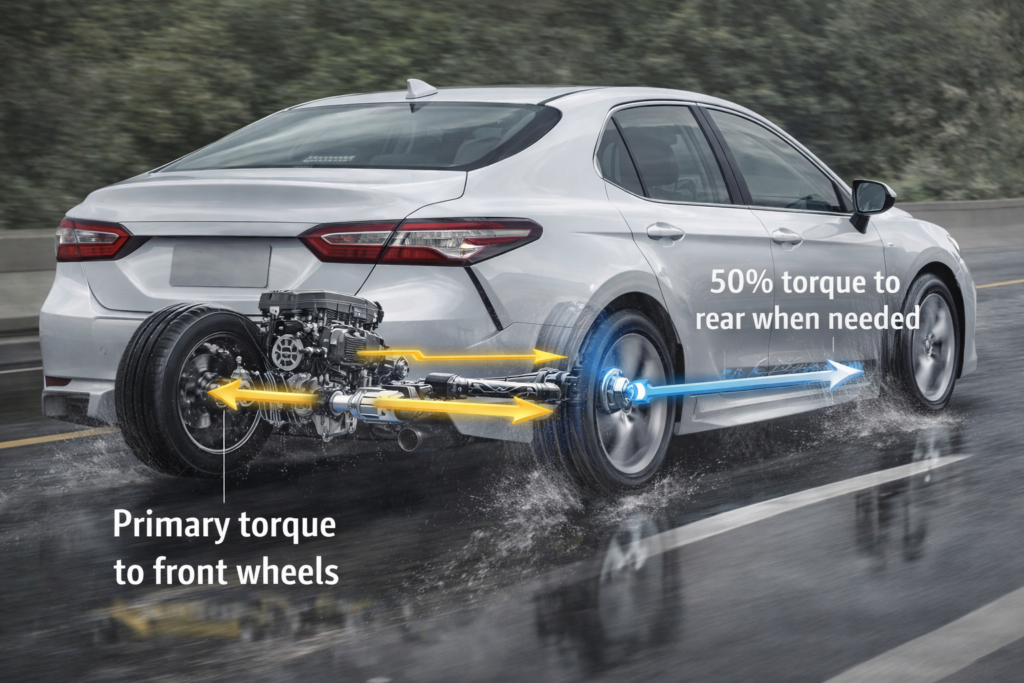
Toyota uses an on-demand system, not full-time AWD. Most of the time, the car operates in front-wheel-drive mode to save fuel.
When the system detects wheel slip, it automatically sends power to the rear wheels. This happens through an electronically controlled coupling. Up to about 50% of the torque can go to the rear if needed.
In normal driving, you would not even feel it switching. It just does its thing quietly.
Check the full technical details in Toyota’s 2020 AWD introduction press release.
Is Camry AWD Full-Time or On-Demand?
It is on-demand AWD, not full-time.
Most of the time, it behaves like a front-wheel-drive car. Power only shifts to the rear when traction drops; once grip returns, it shifts back to FWD. You do not press anything. It is automatic.
Is the Toyota Camry AWD Good in Snow?
In light to moderate snow, it performs confidently. The system quickly shifts torque if the front tires lose grip. I have driven AWD sedans in light snow, and the difference is noticeable at stoplights and on icy turns. It does not turn the Camry into an SUV, though.
However, it does not replace winter tires. Ground clearance is still low compared to SUVs. Deep snow can still be a problem.
For normal winter driving? It is solid. For mountain blizzards? Manage expectations.
Is Camry AWD Better Than FWD in 2026?
It depends on where you live. If you live somewhere with real winters, AWD adds peace of mind. If you are in a warm climate, FWD is honestly enough. Many people buy AWD just in case and never actually need it.
For most city drivers in mild weather, FWD is perfectly fine.
Camry AWD vs Honda Accord:
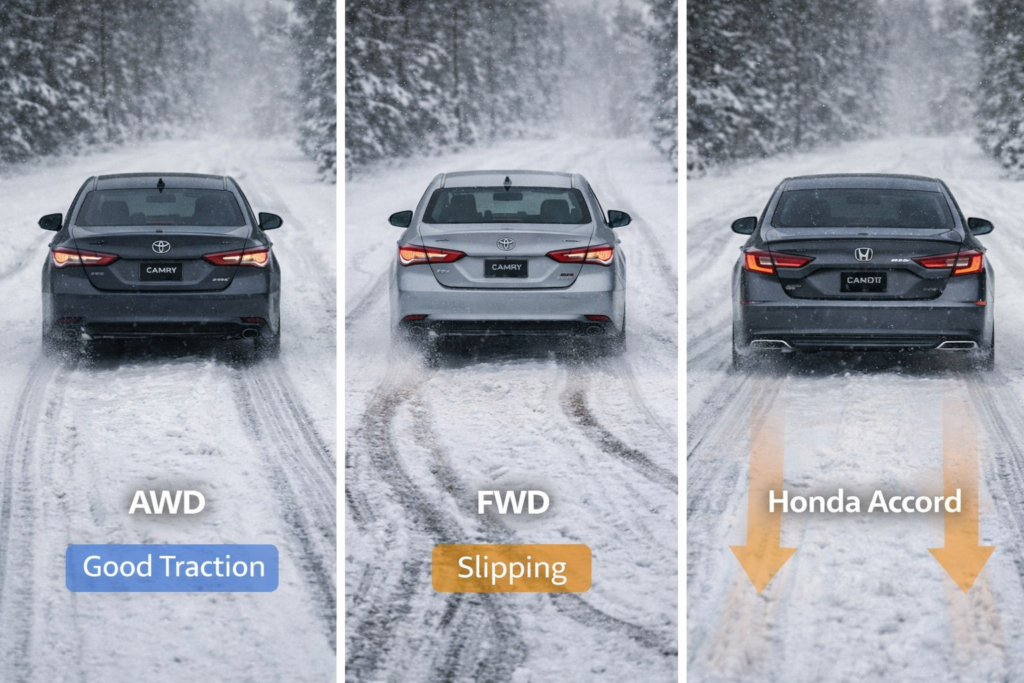
One thing buyers overlook is that the Honda Accord does not offer AWD. If all-wheel drive is non-negotiable for you, the Camry immediately has an advantage in this segment. That alone makes it stand out among midsize sedans.
Does Camry AWD Reduce Fuel Economy?
Yes, slightly. AWD adds weight and extra drivetrain components. That usually lowers fuel economy by 1 to 3 MPG compared to FWD versions. For example, a 2024 Camry LE FWD is rated at approximately 28 city/39 highway MPG, while the AWD version is rated at approximately 25 city/34 highway MPG. The difference is noticeable, but not dramatic.
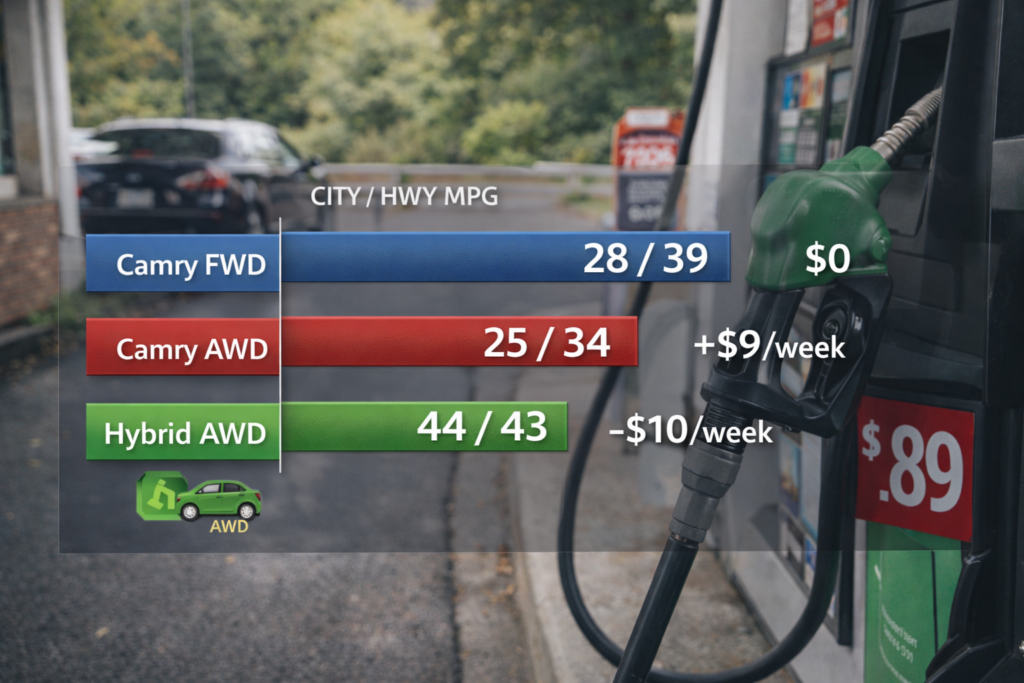
Even with AWD, newer hybrid Camry models deliver around 50 MPG combined in real-world estimates, which significantly narrows the traditional efficiency gap between AWD and FWD sedans.
It is not dramatic, but if you keep the car for five or six years, you will notice it at the pump. If fuel savings are your top priority, FWD wins.
Also Read: Toyota Camry Gas Type
Is the Camry Hybrid Available With AWD?
Yes, on newer redesigned models. Earlier hybrid versions were front-wheel drive only. The updated hybrid system now offers electronic AWD (e-AWD) in select markets.
The rear wheels are powered by a separate electric motor instead of a driveshaft. That design keeps efficiency high while improving traction.
For 2026, this question is simpler than ever: every Camry is now hybrid-powered, and AWD remains optional across much of the lineup. That means buyers no longer have to choose between hybrid efficiency and all-wheel traction.
Read the official announcement here: 2025 Toyota Camry hybrid and AWD details.
Is the Toyota Camry AWD Worth It in 2026?
If you regularly face bad weather, yes. If you do not, maybe not. You pay more up front, and fuel economy drops slightly. But in snow states, that added stability is worth the price.
Drivers in dry, warm regions usually do not need it. It would not make the car more exciting. It just makes it more secure in bad weather.
Many buyers choose AWD for peace of mind rather than necessity. In fact, for many drivers in mild climates, AWD is more psychological than practical. It feels safer, even if they rarely use its capability. And that is fine. But if you have never struggled with traction before, you might not feel a dramatic change day to day
What Changed for the 2026 Camry AWD?
The biggest change is that the Camry lineup is now hybrid-only. Unlike older generations that separated gas and hybrid trims, the latest version combines efficiency with optional AWD across multiple trims. For buyers shopping newer models, the decision is no longer gas vs hybrid it is simply whether AWD is worth adding.
Is Camry AWD Reliable Long-Term?
The AWD system in the Camry is mechanically simpler than full-time AWD setups. It engages only the rear wheels when traction drops, reducing wear compared with always-active systems. So far, there are no widespread reliability concerns specific to Camry AWD models. Maintenance mainly involves standard drivetrain fluid checks.
Some Camry owners have experienced sudden engine shut-offs. See what causes it and whether it is a real concern or a rare case.
Camry AWD vs Snow Tires – What Matters More?
AWD helps you move forward in snow. Winter tires improve braking and handling. In many real-world winter conditions, proper snow tires make a bigger safety difference than the drivetrain alone. Ideally, combining AWD with winter tires gives the best result.
Can You Turn Off Camry AWD?
No, you can not manually switch it off. The system is automatic. It decides when to send power to the rear wheels based on traction.
You just drive normally. The car handles the rest.
People Also Ask About Camry AWD:
Is the Camry AWD reliable?
Is Toyota Camry AWD? Yes. The Camry AWD system is generally considered reliable because it operates on demand rather than in full-time mode. That reduces constant drivetrain stress. There have been no major widespread issues reported with the system.
Is the Camry AWD good in the rain?
It can improve traction during heavy rain, especially during acceleration. However, braking performance depends more on the tires than on the drivetrain.
Is Camry AWD the same as Subaru AWD?
No. Subaru uses a full-time symmetrical AWD system that constantly powers all four wheels. The Camry uses an on-demand system that activates only when needed.
Is AWD worth it over snow tires?
Snow tires usually make a bigger difference in winter driving than AWD alone. AWD improves acceleration, but tires enhance overall grip and braking performance.
FAQ’s:
Is the Toyota Camry AWD available on all trims?
No. AWD is available only on select trims from the 2020 model year onward.
Is the Camry AWD good for winter driving?
Yes, especially in the snow. Just do not skip proper winter tires.
Is the Camry Hybrid available with AWD?
Yes. The redesigned hybrid offers electronic AWD (e-AWD) in certain markets.
Does AWD make the Camry faster?
No. AWD improves traction, not performance, speed, or acceleration.
How much MPG does Camry lose with AWD?
AWD typically reduces fuel economy by about 1 to 3 MPG compared to FWD models.
Conclusion:
The Toyota Camry AWD is not for everyone, but for the right driver, it makes a real difference. If you deal with snow or unpredictable road conditions, it adds significant confidence. If you do not, FWD will likely serve you just fine. It really comes down to where you drive every day.
Whether you choose AWD or FWD, understanding how the system works helps you buy smarter, not just safer.